
Avoid £5–£10 Airport Drop Off Charges in Nottinghamshire & Derbyshire
It depends on the operator. Don’t assume a fixed-price transfer includes terminal drop-off charges unless the confirmation explicitly says “all-inclusive” or “all airport fees included.” Some firms absorb the cost, others pass it through as a separate line, and a few bills it after the ride. If your booking confirmation doesn’t spell it out, ask before you travel, not after.
TL;DR:
- All-inclusive fares are safest, as they include airport terminal drop-off charges within the fixed price, especially at airports with rising fees like Heathrow.
- Always verify in writing whether the quote covers airport fees to avoid unexpected surcharges after the journey, and ask for explicit wording such as “all airport fees included.”
- Drop-off charges typically range from £5 to £10 across UK airports, with short free windows (around 10 minutes) that can trigger additional fees if exceeded.
- Operators may pass through, lump together, or bill terminal fees retrospectively, with the latter being less transparent and more likely to cause disputes.
- For corporate bookings, securing a fixed rate in advance and retaining written confirmation streamlines expense reconciliation and prevents unexpected costs.
Table of Contents
- What does “airport drop off charges” actually mean for your fare?
- What should you ask before you book?
- Why are UK airports changing their drop-off charges?
- How does AirportLift handle terminal drop-off charges?
- What do airport drop-off charges typically cost?
- Do drop-off fees vary by airport, and why?
- Do drop-off charges change how private transfers compare to taxis?
- What should you do if a drop-off charge dispute comes up?
- What do people get wrong about airport drop-off charges?
- Why the “just book the cheapest fare” habit backfires
- Ready to book a transfer with no drop-off surprises?
- Sources
What does “airport drop off charges” actually mean for your fare?
When people search for airport drop off charges, they’re usually trying to work out whether their taxi or transfer firm has bundled the terminal fee into the quoted price. This is different from the drop-off charge itself, which is a fee airports levy on any vehicle using the terminal forecourt, whether it’s a private car, a taxi, or a pre-booked transfer. The operator’s job is to decide who pays it and how it appears on your invoice.
Three models dominate the UK private hire market, and each exists for a practical reason.
All-inclusive pricing. The operator calculates the average airport charge across its regular routes and folds it into the fixed fare. You never see it as a separate line because it’s already priced in. This works best for operators running frequent, predictable routes to the same handful of airports.
Pass-through billing. The fare excludes the terminal fee, which appears as a distinct charge on your invoice or is collected separately. This is common where airport charges vary significantly by drop-off point or change frequently, making a flat average unfair to some customers and generous to others.
Billed after the ride. Less transparent, and worth avoiding if you can. The driver pays the terminal fee at the time, then adds it to your bill retrospectively, sometimes with little warning. This tends to happen with smaller, less structured operators rather than firms with a defined pricing policy.
The reason for the split comes down to how airports charge. Systems using ANPR cameras and online payment windows mean fees can change at short notice, and enforcement (including penalty notices for late payment) makes some operators cautious about guessing at a flat rate. Others simply prefer certainty for both themselves and the customer, so they build it in.
- Look for “all-inclusive” or “all fees included” on your quote
- Treat “additional charges may apply” as a prompt to ask a follow-up question
- Check whether the quote mentions the specific airport by name, which suggests route-specific costing rather than a guess
Pro Tip: If a quote looks unusually cheap compared to others for the same route, ask directly whether the terminal drop-off fee is separate. A too-good price is often a price with something missing.
What should you ask before you book?
Getting the answer in writing matters more than getting a verbal assurance over the phone. A polite question at booking stage takes thirty seconds and saves a dispute later.
- Ask directly: “Does this fare include the airport terminal drop-off charge?” Avoid vaguer phrasing like “is this the total price,” which can be answered honestly while still excluding a pass-through fee.
- Request specific wording on your confirmation. Ask for the phrase “all airport fees included” or an itemised breakdown showing the terminal charge as £0 additional. Either satisfies the same purpose.
- Check the confirmation before you travel, not after. A booking email or text that arrives with vague language (“standard charges may apply”) should prompt a follow-up message asking for clarification in writing.
- For return journeys, confirm both legs separately. Drop-off charges apply to the outbound leg; pickup arrangements at arrivals are a different cost structure entirely, and some operators treat them differently.
- Keep the confirmation. Whether it’s an email, app screenshot, or text, save it. If a dispute arises, this is your evidence that a specific price was agreed.
Corporate bookers have an extra reason to get this right: expense reconciliation. If a driver adds an unexpected charge on the day, that’s an invoice mismatch that finance teams have to chase down. The safer approach for company accounts is to secure a written confirmation that itemises or explicitly states inclusion, then attach that confirmation to the expense claim itself. This creates a paper trail that closes off any argument about what was agreed if an airport later issues a charge notice tied to that journey.
For regular business travel, setting up a corporate account with fixed rates agreed in advance removes this friction altogether, since the pricing terms are settled once rather than re-negotiated on every trip.
Why are UK airports changing their drop-off charges?
Terminal drop-off fees have been rising and tightening across the UK, and that shift is exactly why some operators have moved from absorbing the cost to itemising it. Heathrow raised its terminal drop-off fee to £7 with a 10-minute free window, a change that squeezes operators running short, low-margin routes where the fee eats a larger share of the fare.
Across major UK airports, terminal drop-off fees and free-time caps typically sit in the £5 to £10 range, enforced by ANPR cameras or barrier systems with short online payment windows.
The pattern is consistent even where the exact figures differ. Gatwick, Luton, and Stansted have set fees in a broadly similar band with short free periods, while regional airports such as East Midlands tend to run smaller-scale schemes with their own local rules. What matters for you as a customer isn’t the exact number at each airport. It’s whether your operator has factored that number into your fare or left it for you to discover later.
- Free-time windows are usually short (often around 10 minutes), so a driver waiting for a delayed passenger can trigger a charge
- ANPR enforcement means unpaid fees can escalate into penalty notices if not settled within the operator’s payment window
- Fee levels and free-time rules change periodically, which is why some firms itemise rather than lock in a flat rate
This is precisely why an all-inclusive fare is the lower-risk option for travellers. If the operator carries the exposure to fee changes and enforcement penalties, you don’t have to think about it at all.
How does AirportLift handle terminal drop-off charges?
Some operators have straightforward pricing policies where the fare quoted at booking is the fare you pay, with no separate terminal drop-off surcharge added afterwards. Your booking confirmation should state this clearly, and if it doesn’t, that’s worth flagging before your journey.
Operator transparency around pricing is increasingly a differentiator in this market, and explicit “all-inclusive” wording on a confirmation tends to mean less administrative follow-up for both leisure travellers and corporate expense teams. That’s the standard Airportlift aims to meet on every airport transfer booked across Nottinghamshire and Derbyshire.
Beyond pricing clarity, a handful of operational details matter just as much when you’re trusting a stranger to get you to a flight on time:
- Fully licensed and DBS-checked drivers on every job
- Live flight tracking so your pickup adjusts automatically if your flight is early or delayed
- Meet-and-greet options for travellers who want assistance locating their driver at arrivals
- 24/7 booking availability, useful for early departures or late-night landings
- Trustpilot ratings reflecting customer experience with punctuality and service
Pro Tip: If you’re booking on behalf of a company, ask specifically about corporate account invoicing at the point of setup. A monthly invoice with fixed rates per route is far easier to reconcile than individual receipts collected after each trip.
For corporate clients running regular staff travel, Airportlift’s services page covers account arrangements designed to keep pricing predictable across multiple bookings and travellers.
What do airport drop-off charges typically cost?
Across the UK’s busiest airports, terminal drop-off fees generally sit somewhere between £5 and £10 per vehicle, with a short free-time allowance before the meter starts, so to speak. Heathrow’s current fee is £7, with roughly ten minutes free before charges apply, following its recent increase reported by the BBC. Other major terminals cluster around similar figures, though the exact free-time window and payment method differ from one airport to the next.
Regional airports, including those more relevant to Nottinghamshire and Derbyshire travellers heading to East Midlands Airport, often run smaller, more modest schemes than the major London hubs. The principle is the same everywhere: a short grace period, then a charge that scales with how long the vehicle stays on the forecourt.
For a private operator, this range matters because it sets the ceiling on what they’re deciding to absorb or pass through. A £7 fee on a £60 fixed fare is a meaningful percentage; the same fee on a £120 executive transfer barely registers. That’s part of why some operators build airport charges into every fare as standard, while others treat it as a variable cost tied to the specific route and airport.
None of these figures are fixed forever. Airports revise fees periodically, usually upwards, which is exactly why the wording on your booking confirmation matters more than any number you might find in a general guide. The number that matters is the one on your quote, not the one on a comparison table.
Do drop-off fees vary by airport, and why?
Drop-off charges aren’t standardised across the UK, and the variation comes down to a few consistent factors: airport size, forecourt congestion, and how aggressively each site enforces its charging scheme.
Larger London airports handling high passenger volumes tend to charge more and enforce more strictly, using ANPR systems that read number plates automatically and issue charges without any human intervention. Smaller regional airports often have lower fees or looser enforcement, partly because forecourt congestion is less of a problem and partly because the commercial pressure to monetise every vehicle movement is lower.

Free-time allowances vary too. Some airports offer a slightly longer grace period for genuine drop-offs versus longer-stay parking, while others apply a blanket short window regardless of purpose. This is one reason meet-and-greet or timed pickup services can be genuinely useful. A driver who tracks your flight and times the arrival precisely avoids sitting on the forecourt racking up charges waiting for a delayed passenger.
For operators running routes to multiple airports, as most Nottinghamshire and Derbyshire firms do give the spread of destinations from East Midlands to Birmingham, Manchester, and the London airports, this variation is exactly why a one-size-fits-all pricing model doesn’t always work cleanly. Some build a blended average into every quote; others price each airport individually. Either approach is defensible. What isn’t defensible is leaving you to find out which model applies only after the invoice arrives.
Do drop-off charges change how private transfers compare to taxis?
They do, and often more than travellers expect. A metered taxi’s final price is genuinely unknown until the meter stops, and that uncertainty includes whatever airport fee the driver decides to add, if they add it at all. Some drivers absorb it; others tack it on without much warning, particularly on jobs booked through apps rather than in person.
Rideshare platforms handle this differently again. Many platform apps automatically add and reimburse entry or drop-off fees for trips completed through their own system, which removes some guesswork but still means the final charge can shift depending on live pricing at the moment of booking.
A pre-booked, fixed-price transfer sidesteps both problems. The total price is confirmed before you travel, which removes metered fare variability, vehicle mismatch, and any uncertainty about whether the terminal fee is included, since a reputable transfer operator states the full cost upfront.
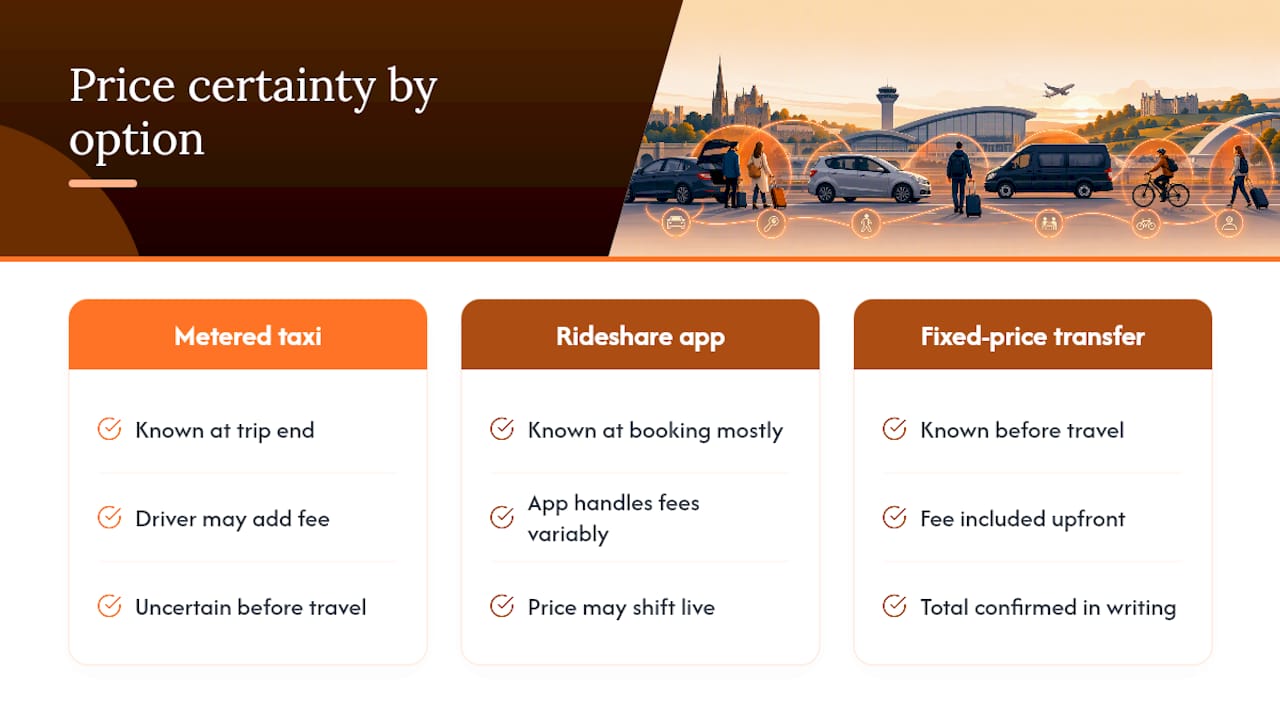
For a straightforward cost comparison, the headline fare isn’t the whole story. A taxi quoted slightly cheaper than a fixed transfer can end up costing more once a drop-off surcharge, a longer wait, or a diverted route are added. The fairer comparison is the total cost you’ll actually pay, confirmed in writing, against the total cost of an alternative that might still carry hidden variables at the point of arrival.
What should you do if a drop-off charge dispute comes up?
Start with your written confirmation. If your booking stated the fare was all-inclusive and you’re later billed an extra amount, that confirmation is your strongest evidence, so raise it with the operator directly and reference the specific wording you were given.
Most reputable operators will resolve this quickly once shown the original confirmation, because a documented pricing error damages their reputation far more than the cost of correcting it. If the confirmation was ambiguous, for instance if it said “standard charges may apply” without defining what that meant, the conversation becomes more about clarifying intent than proving a breach.
For corporate bookings, escalate through the account manager rather than the individual driver. Fixed-rate corporate accounts typically have clearer terms precisely because they’re negotiated in advance, which makes disputes easier to resolve by referring back to the agreed rate card rather than a one-off verbal exchange.
If a dispute can’t be resolved directly, most transfer bookings are covered by standard consumer protections around misrepresented pricing. Keep every piece of correspondence, the original quote, the confirmation, and any messages exchanged about the charge, since a clear paper trail resolves most disagreements without needing to go further.
The practical lesson is prevention rather than cure. A five-minute check before booking costs nothing. A dispute after the ride costs time, and occasionally goodwill, on both sides.
What do people get wrong about airport drop-off charges?
The most common misconception is assuming that “fixed price” automatically means “all-inclusive.” A fixed price simply means the fare won’t change due to traffic, distance recalculation, or demand surges. It says nothing, on its own, about whether the airport’s terminal fee sits inside or outside that number. These are two separate promises, and conflating them is where most surprises come from.
A second misconception is that airport drop-off charges are a scam or an unfair add-on invented by transfer companies. They’re not. These are fees set and enforced by the airports themselves, not by your driver, and inclusion in a fare is entirely at the operator’s discretion rather than a legal requirement either way. The charge is real; the question is only who absorbs it.
A third misconception, common among occasional travellers, is assuming rideshare-style automatic fee handling applies to every private hire booking. It doesn’t. Platform-based automatic reimbursement is a feature of specific apps, not a universal standard, and a privately booked transfer depends entirely on that operator’s own stated policy.
Finally, some travellers assume that asking about inclusion will make them seem difficult or overly cautious. It won’t. Any operator confident in its pricing will answer the question plainly and put it in writing without hesitation.
Why the “just book the cheapest fare” habit backfires
Most advice on this topic focuses on comparing headline prices, and that’s precisely where it goes wrong. The number on a quote tells you almost nothing about total cost until you know what it excludes. A £45 quote with a hidden £7 airport surcharge and a vague pickup window isn’t cheaper than a £52 quote that’s genuinely all-inclusive with tracked pickup, it’s just less honest about the maths.
What the research on UK airport fee enforcement actually supports is this: the operators who itemise or absorb charges transparently tend to be the ones with structured pricing policies in the first place, and structured pricing correlates with reliability elsewhere too, punctuality, driver vetting, corporate invoicing. Price clarity isn’t a cosmetic feature. It’s a signal about how the whole operation is run.
Corporate bookers, in particular, should prioritise the written confirmation over the quoted number every single time. A rate card with no ambiguity saves more in reconciliation time than any marginal saving on the headline fare. For leisure travellers, the fix is simpler still: ask the direct question, get the direct answer in writing, and book accordingly.
Ready to book a transfer with no drop-off surprises?
Airportlift removes the guesswork that comes with metered taxis and vague quotes by confirming your full price, including any airport terminal charges, before you travel. That’s the practical difference for anyone booking from Nottinghamshire or Derbyshire: one number agreed upfront, with nothing added once you’re at the terminal.
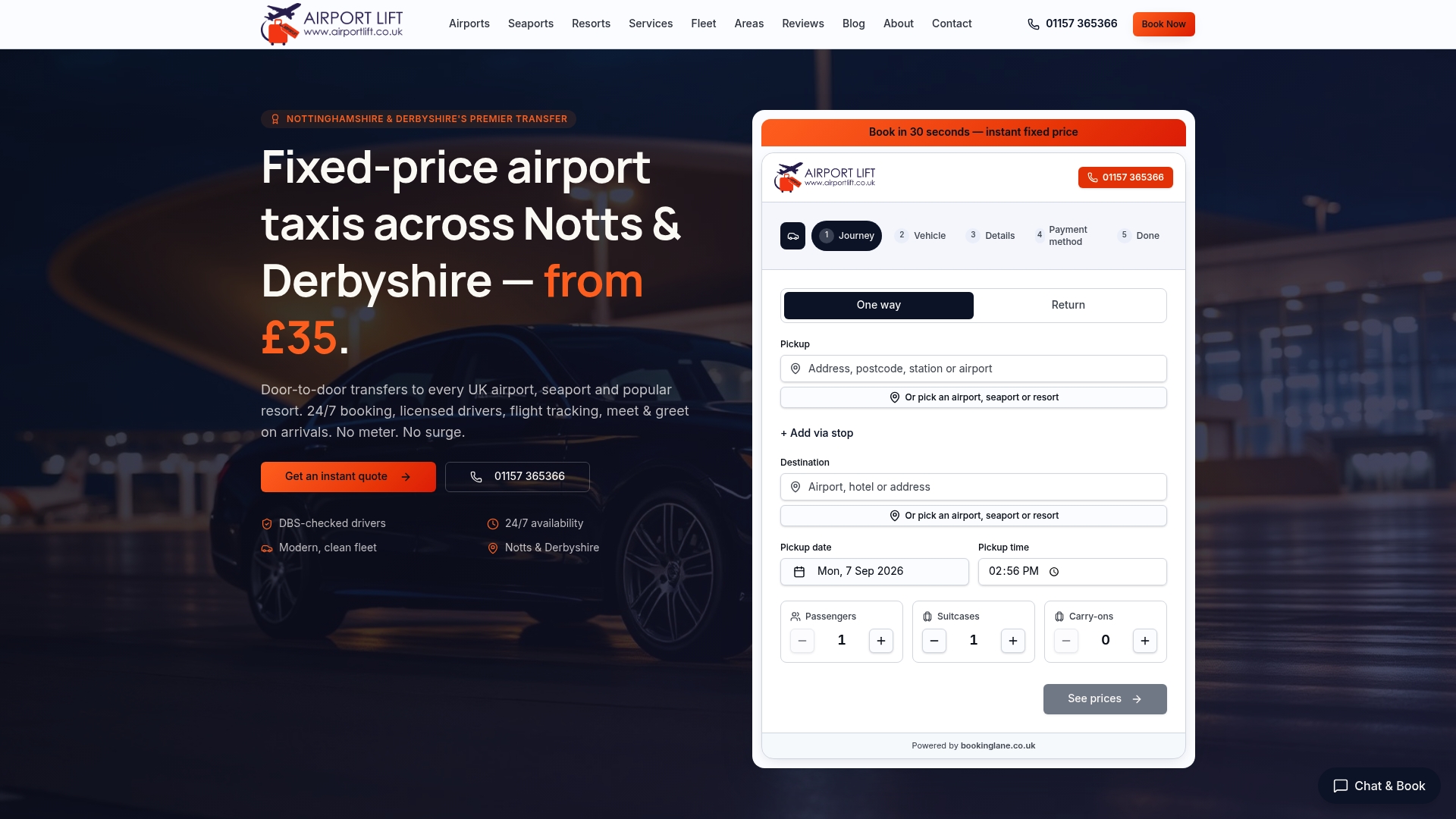
Booking takes a few minutes through the instant online quote tool, by phone, or through a corporate account set up in advance for regular business travel. Whichever route you choose, your confirmation will state the total price clearly, so there’s nothing to query when you’re dropped at the terminal. If you’re travelling from further afield, the airport-specific route pages show fixed fares for major UK airports, so you know the exact figure before you commit. Get your quote, check the confirmation wording, and travel knowing the price won’t change between booking and drop-off.
Sources
- Heathrow Airport announces changes to drop-offs - BBC News
- Airport drop-off charges: what taxi and private hire drivers need to know | insurd®