
Diverted Flight Taxi: Getting Home and Claiming the Cost

If your flight lands at a different airport from the one you booked, the airline should organise, or pay for, the journey to your booked airport or another nearby destination you agree with it. If it does not, you can arrange a reasonably priced taxi yourself, keep every receipt and claim the cost back. We run fixed-price transfers from Nottinghamshire and Derbyshire to UK airports, so this guide covers both sides: your rights, and how to get home without a surprise fare.
TL;DR
- Ask airline or handling-agent staff first what transport is arranged and where it goes. Do not book a taxi until you know.
- If the airline offers a flight to an alternative airport, UK261 says it must pay to transfer you to your booked airport or another nearby destination agreed with you.
- If no workable transport is provided, book a reasonably priced taxi, coach or train, keep the receipt and record when and how you asked for help.
- Taxi costs and compensation are separate claims. Extraordinary circumstances can remove compensation, but not your right to care and assistance.
- A pre-booked fixed-price driver who tracks your flight can be waiting wherever you land. Get an instant quote.
Table of Contents
- What actually happens when a flight is diverted
- The first ten minutes after landing
- Will the airline pay for your taxi?
- How to claim the taxi cost back
- Taxi costs versus compensation
- Keeping the onward journey affordable
- What families and business travellers should check
- How a pre-booked transfer handles a diversion
- Our view on diversions
- Book a fixed-price transfer before you fly
- FAQ
- Sources
What actually happens when a flight is diverted
A diversion means the aircraft lands somewhere other than its scheduled airport. The usual causes are weather, a medical emergency on board, a runway closure or a technical fault. Passengers are then either held on the plane, bussed to the original airport, or released at the new airport to make their own way.
What you are owed depends on what the airline does next. UK261, the UK version of Regulation (EC) No 261/2004, says that where an airline offers a flight to an alternative airport and the town, city or region has several airports, it must bear the cost of transferring you to the booked airport or another nearby destination agreed with you.
The UK Civil Aviation Authority (CAA) applies this in its guidance on re-routing. It says airlines should organise transport when re-routing passengers to or from a different airport, and if they fail, they should promptly reimburse the expenses you incur travelling to or from the alternative airport.
Three things follow from that:
- The airline is expected to arrange the onward journey. You are not expected to find it.
- If it does not, you may arrange your own and claim afterwards.
- The claim is for reasonable cost, not any cost.
UK261 generally covers flights departing a UK airport on any airline, flights arriving in the UK on a UK or EU airline, and flights arriving in the EU on a UK airline, according to the CAA. A flight on a non-UK, non-EU airline arriving in the UK may fall under different rules, so check which applies to your booking.
The first ten minutes after landing
What you do straight away shapes any claim later. Work through this in order:
- Find airline or handling-agent staff. Look for a desk, a person in uniform or a message on the airline app. Ask what transport is arranged, where it goes and when it leaves.
- Ask for it in writing. A text, email or app message is ideal. If staff only tell you verbally, note their name, the time and what they said.
- Photograph the departures board and any notices. They show the diversion and the time you were told.
- Tell whoever is meeting you. If you have a pre-booked driver, call or message them now, so they can reposition.
- Decide on a deadline. If there is no clear plan after a reasonable wait, move to arranging your own transport.
The CAA’s guidance is clear on what to do if help does not arrive: arrange a reasonably priced taxi, coach or train, retain the receipt, and keep a record of when and how you asked the airline for help.
Do not feel you must wait indefinitely. At a small airport late at night after a mass diversion, staff can be overwhelmed. The CAA says that when an airline cannot arrange required care during major disruption, passengers may make reasonable arrangements themselves and claim the cost back later.
Will the airline pay for your taxi?
Often yes, but not always, and not without a trail of evidence. Three situations come up most.
The airline offers a coach or organised transfer
Take it if it gets you where you need to be in reasonable time. The CAA’s approach is that it organises reasonable care only when the airline fails to provide it. If an organised transfer is on offer and you independently choose a pricier taxi, you may find it hard to prove the expense was reasonable. If the coach will leave in several hours and you have a child with you, say so to staff and record their answer.
The airline offers nothing
Then the cost of getting from the alternative airport to your booked airport or agreed destination is a legitimate expense. Book something proportionate. A licensed taxi or pre-booked transfer over a sensible distance is easier to defend than a premium vehicle chosen for comfort.
The diversion leaves you with an overnight wait
UK261 Article 9 covers more than transport. It requires free meals and refreshments in reasonable relation to the waiting time, hotel accommodation when an overnight stay becomes necessary, transport between the airport and accommodation, and two telephone calls, faxes or emails.
GOV.UK gives the thresholds for care: a delay of more than 2 hours for flights under 1,500 km, more than 3 hours for flights of 1,500 to 3,500 km, and more than 4 hours for flights over 3,500 km, per its air passenger travel guide.
How to claim the taxi cost back
Reimbursement is not automatic. The CAA says you should contact the airline or airport directly, normally using its claims procedure or form. If there is no standard procedure, email may be best because you then have a record of the communication.
What to keep
- The taxi or transfer receipt, showing date, time, route and amount
- Your booking confirmation and boarding pass
- Screenshots of airline messages, app notifications and flight-tracking pages
- Photos of boards or notices at the alternative airport
- Notes on who you spoke to, at what time, and what you asked for
GOV.UK advises claimants to provide the flight number, booking reference, departure and arrival airports, disruption details and delay length. Put all of those at the top of your email so the claims handler does not need to ask.
The CAA’s wording implies that written evidence of the airline’s failure to arrange transport strengthens a later claim. That is why messages, screenshots, staff names and times matter as much as the receipt.
A simple claim email
Keep it factual: your name and booking reference, the flight number and date, where you were meant to land and where you did land, what transport you asked for and when, what you were told, what you paid, and the amount you are claiming. Attach the receipt and screenshots. Ask for a reply within a stated period, and keep a copy.
GOV.UK also says that if you pay for necessities yourself you should spend only reasonably and check with the airline where you are unsure what counts as reasonable. A quick message to the airline before you book, with the reply saved, protects you if the fare is large.
Taxi costs versus compensation
These are two different claims, and people often mix them up.
| Taxi or onward travel cost | Compensation | |
|---|---|---|
| What it is | Reimbursement of reasonable expense | A fixed sum for the delay |
| Based on | Care and re-routing duties | Length of delay on arrival at your final destination |
| Affected by weather or strikes? | No, the right to care and assistance remains | Yes, extraordinary circumstances can remove it |
| Evidence | Receipts, messages, times | Flight details, arrival time |
The CAA says extraordinary circumstances such as extreme weather, airport strikes or air-traffic-control strikes can remove entitlement to fixed compensation, but not the separate right to care and assistance. Most diversions are weather or safety related, so compensation is often not payable, yet the taxi claim may still stand.
Where compensation does apply, GOV.UK says arrival more than 3 hours late at the final destination may qualify, unless extraordinary circumstances caused the delay. The amounts on legislation.gov.uk are £220 for flights up to 1,500 km, £350 for 1,500 to 3,500 km and £520 for longer flights, subject to the regulation’s conditions. The distance is measured to the last destination at which the delay will affect your arrival after the scheduled time.

Keeping the onward journey affordable
A diversion often means a long, late-night ride, and unplanned fares can climb. A few habits keep the bill sensible, and sensible bills are the easiest to reclaim.
- Compare the options quickly. Train, coach and taxi each suit different hours and distances. At 2am, a taxi may be the only realistic choice. At midday, a train may be quicker and cheaper.
- Agree the price before you get in. Metered cabs outside a busy airport at peak demand can cost far more than you expect. A fixed quote removes the guesswork.
- Share where you can. If several passengers from your flight are heading the same way, one larger vehicle can cost less per head than separate cabs.
- Avoid paying twice. If you have already booked a driver for your booked airport, tell them about the diversion before you pay anyone else. Some drivers can reroute; some cannot.
- Stay proportionate. Pick the standard vehicle that fits your party, not the top of the range, if you intend to claim.
If your diversion happens at the start of a trip, for example a departure flight that is moved away from your home airport, our post on when a licensed cab beats an airport hotel or taxi explains how to weigh the costs. For East Midlands Airport journeys, our guide to airport parking and when a taxi wins covers the alternative.
What families and business travellers should check
Families
- Seats and luggage. Four adults and their cases will not fit a standard saloon. We run 8-seater minibuses for groups and families, which avoids splitting across two cabs.
- Child seats. If you need one, ask before you book and make sure the driver confirms it.
- Timing. Tired children make a late wait harder. If staff cannot name a transfer time, a taxi may be reasonable, and your notes on the wait support the claim.
- Food and drink. Keep receipts. Meals and refreshments in reasonable relation to the wait are part of the care duty.
Business travellers
- Invoices. Ask for a receipt that shows the route and the amount. Employers and airlines both want paperwork.
- Policy. Check your company’s travel policy before you spend. Some employers reimburse regardless of what the airline pays, which can be faster.
- Meeting times. Tell your contact the new arrival time as soon as you know it.
- Accounts. If you travel often, a corporate account with monthly invoicing keeps these journeys on one statement. Our executive travel service covers that.
How a pre-booked transfer handles a diversion
A pre-booked driver works better in this situation than a rank taxi, because a plan is already in place. With Airport Lift, flight tracking is part of the service, so we can see when a flight has changed course. Tell us as soon as you land and we will advise what we can do. Meet-and-greet is also available, which helps at a large terminal where you arrive tired and unsure where to go. See our meet and greet page for details.

Our drivers are licensed and DBS-checked, and booking is open 24 hours a day, which matters when a diversion lands you at 3am. Prices are fixed at the time of booking with no hidden fees or surges.
For reference, these are our published one-way fixed prices from Nottinghamshire and Derbyshire to major airports, as listed on our airports page:
| Airport | Fixed price |
|---|---|
| East Midlands Airport | £35 |
| Leeds Bradford Airport | £70 |
| Birmingham Airport | £75 |
| Manchester Airport | £100 |
| London Luton | £120 |
| London Stansted | £130 |
| London Heathrow | £160 |
| London Gatwick | £170 |
If you are diverted on the way back from a cruise, our seaport and cruise transfers are priced the same way, for example £280 to Southampton Cruise Port.
Our view on diversions
We hear the same story from travellers after a diversion: nobody told them what would happen next, and the only certain thing was a stranger quoting a price at the kerb.
Our approach is to remove the unknowns you can control. A fixed price agreed in advance means you know the cost of the journey home before anything goes wrong. Flight tracking means we know your flight has moved without you having to explain it. Round-the-clock booking means a late change is not left until morning.
If the diversion is the airline’s responsibility, keep the receipt and claim. If it is not, you still have a clear figure and a driver you can trust. In both cases you spend less time bargaining and more time getting home.
AirportLift
Book a fixed-price transfer before you fly
If you want certainty at either end of your trip, we can quote in seconds. Tell us your pick-up, your airport and your flight details, and you get a fixed price with no hidden fees and no surge pricing. Airport transfers, executive cars and 8-seater minibuses are all available, with 24/7 booking.
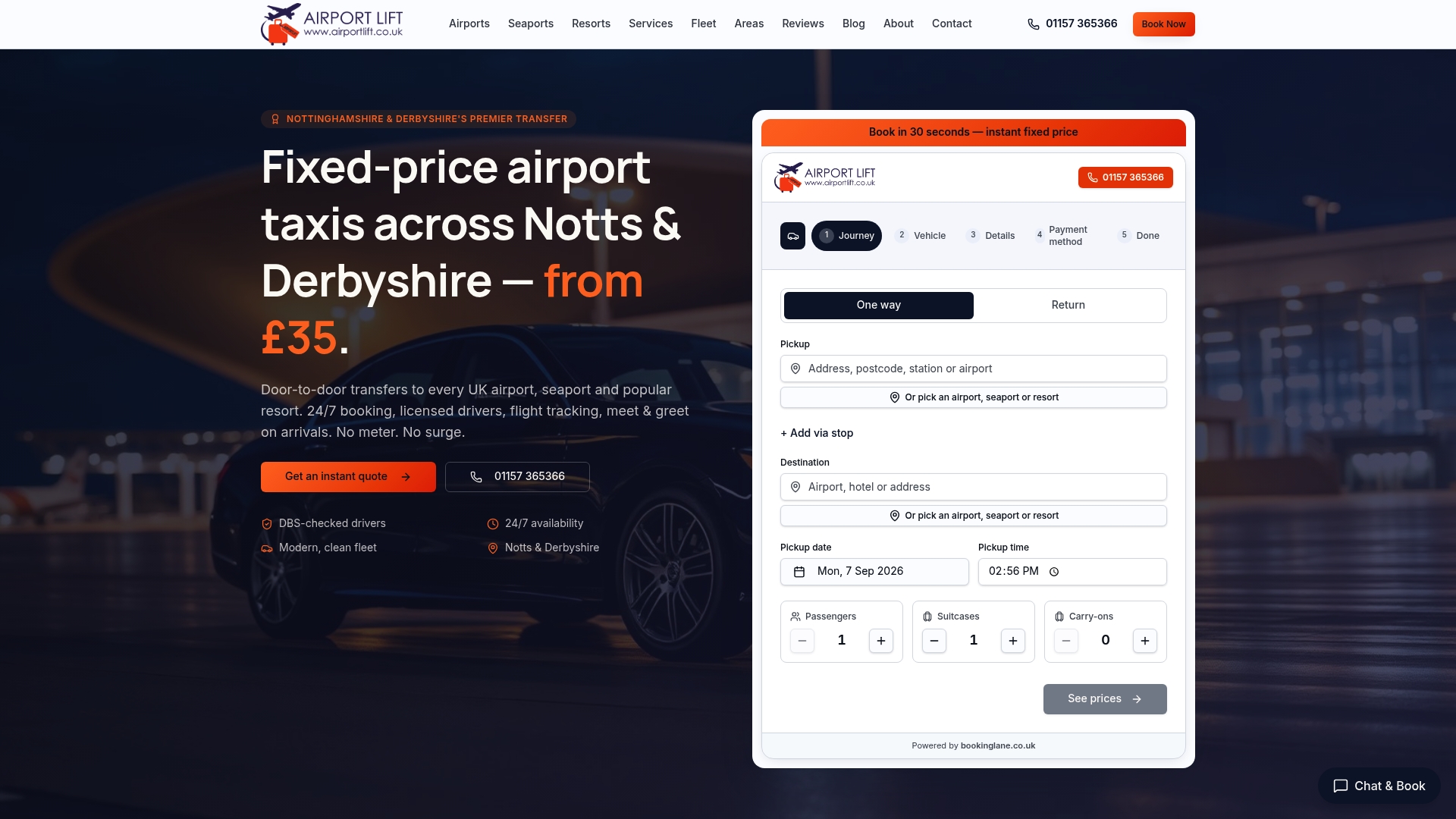
You can book an airport taxi with an instant quote, or look at the full range on our services page. If your plans change after a diversion, contact us as early as you can so we can work out the best option.
FAQ
What happens when a flight gets diverted?
The aircraft lands at a different airport, and the airline then decides how to get you to your destination. Under UK261 you are entitled to care and assistance during significant delays, and if the airline offers a flight to an alternative airport it must pay to transfer you to your booked airport or another agreed nearby destination. Ask staff what is arranged before you make your own plans.
Can I claim compensation for a diverted flight?
Possibly. GOV.UK says arriving more than 3 hours late at your final destination may qualify, unless extraordinary circumstances caused the delay. Weather and similar causes often remove compensation but not your right to care. Check whether UK261 covers your flight, then claim through the airline’s own procedure.
Should I wait for the airline’s transport or book my own taxi?
Ask first, and take organised transport if it gets you there in reasonable time. If nothing workable is provided, arrange a reasonably priced taxi, coach or train and keep the receipt. Record when and how you asked the airline for help, because that record supports your claim.
What evidence do I need to claim the taxi fare?
Keep the receipt, your booking confirmation, screenshots of airline messages and notes on who you spoke to and when. GOV.UK advises including your flight number, booking reference, airports, details of the disruption and the length of the delay. Send it by email so there is a record.
Sources
- Regulation (EC) No 261/2004, legislation.gov.uk
- Article 9 of Regulation (EC) No 261/2004, legislation.gov.uk
- Re-routing in accordance with Article 8, UK Civil Aviation Authority
- Cancellations, UK Civil Aviation Authority
- Claiming for costs and compensation, UK Civil Aviation Authority
- Air passenger travel guide, GOV.UK