
Airport Transfers: Lock a £35 Fixed Fare or Risk a Metered Taxi

For airport transfers and any pre-booked longer journey, a fixed price nearly always beats a metered fare, because it removes the risk of traffic and delays inflating your bill. Metered taxis usually work out cheaper only on short, direct trips in light traffic. Operators often build entire airport services around fixed-price quotes for exactly this reason.
TL;DR:
- Fixed fares are ideal for airport transfers and long journeys because they eliminate the risk of traffic delays inflating the cost, with confirmed written quotes before departure.
- Metered taxis charge based on flagfall, distance, and time, which can lead to higher costs during congestion or extended waiting periods, especially at airports.
- Fixed fares typically include the main route, but extra stops and tolls may incur additional charges, so confirm what’s included in writing upfront.
- Metered taxis are usually cheaper for short, direct trips in light traffic where delays are unlikely, making them more suitable for spontaneous, local hails.
- Booking a fixed-price transfer early guarantees availability and certainty during peak travel times and unpredictable conditions, especially for flights or heavy luggage.
Table of Contents
- What is a fixed-fare (fixed price) taxi?
- What is a metered taxi and how does the meter affect cost?
- Fixed vs metered: pros, cons, and the traffic risk
- When fixed fares are usually the better choice
- When metered taxis can be the cheaper option
- How to choose: your pre-booking checklist
- Practical booking tips to avoid hidden charges
- How Airport Lift UK applies fixed pricing to airport transfers
- Why we recommend fixed pricing for airport arrivals
- Book a fixed-price transfer with confidence
- Sources
- FAQ
What is a fixed-fare (fixed price) taxi?
A fixed fare is a price you agree before you travel, and it stays the same no matter what happens on the road. Sit in traffic for forty minutes past the estimate and the driver still charges the figure you were quoted, not a penny more. This is the model most pre-booked transfers and app quotes use, and it’s the standard for airport-run pricing across most operators.
- The price is confirmed at booking, before the driver moves
- It typically covers the agreed route, so extra stops or detours may cost more
- Tolls, car parking charges, and airport pick-up fees are sometimes separate, so always check
- You should get written confirmation of the total, whether by email, text, or app screen
Never accept a verbal quote alone. If the confirmation you receive doesn’t state the total figure, ask for it again before the driver sets off.
What is a metered taxi and how does the meter affect cost?
A metered taxi charges a flagfall (the amount shown the moment you get in) plus additional charges for distance covered and time elapsed. The meter starts running the second the journey begins, and it keeps adding small increments for every minute you’re stationary in traffic just as it does for every mile you cover.
- Flagfall: a fixed starting charge, regardless of distance
- Per-mile charges: added as the vehicle moves
- Per-minute charges: added when the vehicle is stopped or moving slowly, which is why congestion inflates metered fares
- Rates can also shift by time of day or distance band, depending on the local tariff structure
Metered fares tend to be cheapest on short, uncongested routes, where there’s little time for those per-minute charges to accumulate.
Fixed vs metered: pros, cons, and the traffic risk
The choice comes down to five practical dimensions: price predictability, exposure to traffic, suitability for airport runs, flexibility for route changes, and booking convenience. Fixed fares win comfortably on the first three. Metered fares win on flexibility, since you can add stops or change your mind mid-journey without renegotiating a price.
- Price predictability: fixed fares are locked in; metered fares vary with every red light
- Traffic exposure: fixed fares absorb delays for free; metered fares charge you for every minute stuck
- Airport suitability: fixed fares handle flight delays and terminal confusion without penalty; metered fares can run up quickly during unpredictable pickup queues
- Route flexibility: metered fares adapt naturally to detours; fixed fares may need renegotiating
- Booking convenience: fixed fares usually require pre-booking; metered fares can be hailed on the spot
Fixed fares are not automatically more expensive. Travel guides comparing the two models consistently find that fixed fares suit pre-booked and airport journeys, while metered fares suit short, direct trips, rather than one model being universally cheaper. There’s also a theoretical reason fixed pricing holds up so well: platforms tend to favour flat rates specifically when congestion is high or when passengers dislike watching the fare climb, because that anxiety, sometimes called the “ticking meter effect,” pushes people toward certainty even if the fixed price is marginally higher on a clear run.
When fixed fares are usually the better choice
Certain trips carry enough uncertainty that a fixed price stops being a nice-to-have and becomes the sensible default.
- Airport runs — flight delays, terminal changes, and variable traffic on the approach roads all favour a locked-in price
- Late-night or early-morning flights — fewer taxis on the road can mean longer waits, which a metered fare would charge you for
- Large groups or heavy luggage — bigger vehicles and multiple stops complicate a meter-based estimate
- Known congested corridors — routes through city centres or motorway pinch points at peak times
- Events and bank holidays — surge-prone periods where demand spikes push metered and dynamic pricing upward
A published fixed price makes the point concretely: a route quoted at a flat rate stays that figure whether the road is clear or gridlocked, which is precisely why fixed pricing dominates airport transfer bookings.
Pro Tip: Book your fixed-price transfer as soon as your flight is confirmed, not the night before. Early booking rarely affects the price, but it guarantees availability during peak travel weeks.

When metered taxis can be the cheaper option
Metered fares earn their place when a journey is short, straightforward, and unlikely to hit heavy traffic.
- Short local journeys of a mile or two in light traffic
- Trips where the destination might change en route
- Impromptu hails from a taxi rank, where pre-booking isn’t practical
- Off-peak times when waiting-time charges are unlikely to build up
Before you get in, glance at the road ahead. If it’s clear and the trip is short, the meter will likely stay low. If you can see queuing traffic or roadworks, a fixed quote from a nearby operator may serve you better.
How to choose: your pre-booking checklist
Work through five factors before deciding: trip length, traffic risk, passenger and luggage count, how much the schedule matters, and your own tolerance for price uncertainty. A short, light-traffic hop tips towards metered. A long, time-sensitive, or luggage-heavy trip tips towards fixed.
- Estimate the trip length and check current traffic conditions
- Count passengers and luggage, since larger groups often need pre-booked vehicles anyway
- Weigh how much a delay would cost you if you miss a flight or meeting
- Decide whether you’d rather pay slightly more for certainty or risk a lower average cost
Ask these exact questions before you book or step into the cab:
- “Is this a fixed price, and is it confirmed in writing?”
- “Does this include tolls and parking?”
- “What happens if my flight is delayed?”
- “How long is the free waiting allowance?”
Treat a refusal to answer any of these as a red flag. Walk away, or insist on a written booking confirmation before you travel.
Practical booking tips to avoid hidden charges
For fixed fares, confirm the total price and every inclusion in writing before the driver arrives, not after you’ve landed. For metered rides, estimate the likely cost beforehand using a mapping app to check distance and current traffic, so you’re not caught off guard by the final reading.
- Ask upfront whether card payments carry a surcharge, since some operators add separate charges for tolls or card processing
- Always request a receipt, whether the fare was fixed or metered
- Confirm cancellation policy and any waiting-time allowance before you commit
Pro Tip: For airport pickups specifically, ask whether the operator offers flight tracking and meet & greet. Both features remove the guesswork around delayed landings, so you’re not billed for time spent waiting at the wrong door.
How Airport Lift UK applies fixed pricing to airport transfers
Some operators build airport transfer services around the fixed-price principle discussed throughout this guide, pairing the fixed quote with features designed to close the gaps where metered fares usually go wrong.
- Fixed-price quotes confirmed before the driver sets off, with no surge pricing on delayed flights
- Flight tracking, so the pickup time adjusts automatically if your plane lands late
- Meet & greet at the terminal, removing ambiguity around where and when to find your driver
- Licensed, vetted drivers for accountability and safety
- Round-the-clock booking availability for early departures or late arrivals
Published examples on the Airport Lift UK site illustrate the model in practice: Nottingham to East Midlands Airport is quoted from £35, and Nottingham to Birmingham Airport runs at a fixed £75 for roughly 1 hour 15 minutes, regardless of traffic on the route.
Why we recommend fixed pricing for airport arrivals
Airport travel carries too many variables, delayed flights, unpredictable queues, heavy luggage, for a ticking meter to make sense as the default. Short local hops are the exception. Run the checklist above, and book with certainty when it counts.
— AirportLift
Book a fixed-price transfer with confidence
Some operators remove the traffic-risk problem this guide has walked through: your price is fixed the moment you book, so a delayed flight or traffic jam never changes what you pay. That’s the real advantage over a metered ride for any airport journey, certainty from the first confirmation to the final drop-off.
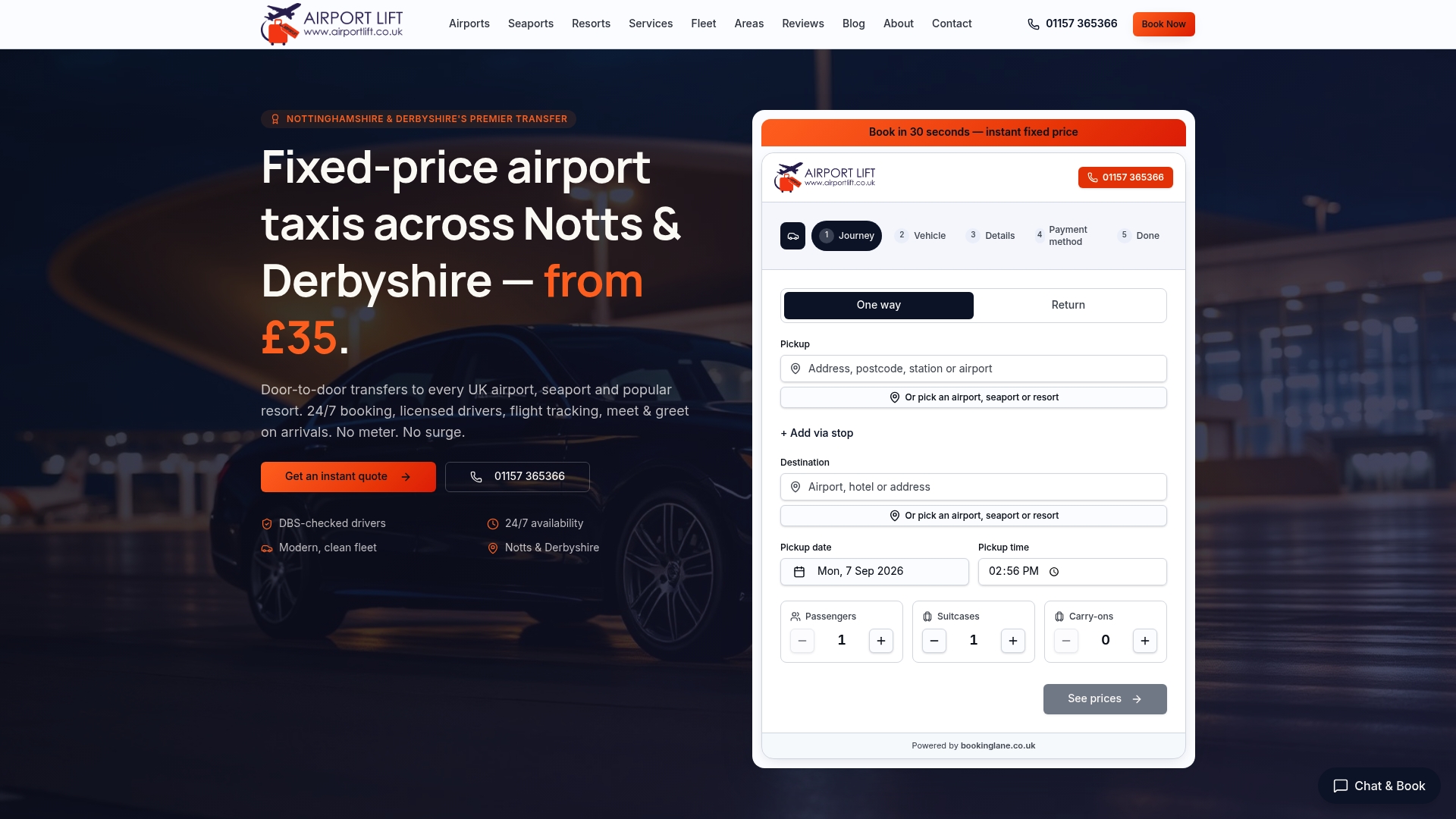
The service includes flight tracking, meet & greet at the terminal, and fully licensed, DBS-checked drivers, all built around the fixed quotes shown at booking. Published examples like Nottingham Airport taxis from £35 give you a sense of what a transparent quote looks like before you commit. If your next trip involves a flight, a long route, or a group with luggage, get an instant fixed-price quote and lock in your fare before you travel.
Sources
This guide draws on comparative research into fixed and metered taxi pricing, meter mechanics and congestion effects, and game-theoretic pricing models. To book directly, visit Airport Lift UK’s services page.
- Research on pricing models in ride-hailing platforms (game-theoretic analysis)
- Comparing fixed fare and metered taxi services in Edinburgh | GetRyde
- Taxi-fare
FAQ
What does a taxi fixed price mean?
A fixed price is a total fare agreed before the journey starts, which does not change regardless of traffic, waiting time, or route delays.
What does fixed fare mean in a taxi?
It means the same as fixed price: a pre-agreed total that the driver charges at the end of the trip, confirmed in writing at booking.
How much should a 15-minute taxi ride cost?
There’s no single figure, since metered costs depend on the local tariff, distance covered, and traffic; a fixed-price operator can quote an exact total in advance for that specific route.
Can taxis charge more for using a card?
Some operators add a separate card-payment surcharge, so it’s worth asking about this at booking, whether you’re taking a fixed-price transfer or a metered ride.