
Manchester vs Birmingham: 21% Higher Rent, Which City Fits Your Life?

Neither Manchester nor Birmingham wins this comparison outright, because they’re not competing on the same terms. Manchester leads on culture, nightlife and creative or tech careers; Birmingham leads on affordability, family space, and urban scale. Even the “second city” title, contested between the two for decades, depends entirely on which measure you choose to trust.
TL;DR:
- Birmingham has a larger city-proper population at about 1.14 million, while Manchester’s city proper is around 550,000, but Manchester’s metro area is comparable in size.
- Rent in Manchester averages £1,347 monthly, which is about 21% higher than Birmingham’s average of £1,086, despite similar median earnings.
- Manchester excels in culture, nightlife, and tech careers, whereas Birmingham offers lower costs, more family space, and a broader urban scale.
- Airport connectivity favors Manchester with more long-haul routes, while Birmingham’s central rail position provides better intercity travel options.
- Both cities are highly diverse and sport strong football traditions, but Manchester’s music scene and Birmingham’s museums and culinary scene cater to different lifestyle priorities.
Table of Contents
- Manchester vs Birmingham at a glance
- Why do population figures for Manchester and Birmingham vary so much?
- How do the Manchester and Birmingham economies compare?
- Which city costs less to live in: Manchester or Birmingham?
- What’s the culture and nightlife like in Manchester compared with Birmingham?
- How easy is it to travel to and around Manchester and Birmingham?
- Which city has stronger universities and student life?
- How green and liveable are Manchester and Birmingham?
- How do Manchester and Birmingham compare on safety and crime?
- Why do both cities call themselves the UK’s second city?
- How should you decide between Manchester and Birmingham?
- What are healthcare services like in Manchester and Birmingham?
- What’s happening in the Manchester and Birmingham housing markets?
- What are the must-see landmarks in Manchester and Birmingham?
- How diverse are Manchester and Birmingham?
- Which sports teams define Manchester and Birmingham?
- A note on how this guide was put together
- Where to check the figures yourself
- Sources
Manchester vs Birmingham at a glance
Before getting into the detail, it helps to see the headline numbers side by side. These figures combine city and metro population data with cost-of-living and climate averages, pulled from sourced comparisons rather than guesswork.
| Metric | Manchester | Birmingham |
|---|---|---|
| City population | Approx. 550,000 | Approx. 1.14 million |
| Metro/combined authority population | Greater Manchester: 2 to 2.8 million | West Midlands metro: 2.4 to 2.9 million |
| Average monthly rent | £1,347 | £1,086 |
| Median earnings | £30,067 | £30,180 |
| Annual rainfall (Met Office average) | Higher in Manchester than in Birmingham, reflecting Manchester’s wetter climate | Less in Birmingham, reflecting a drier climate |
| Main airport | Manchester Airport | Birmingham Airport |
The population ranges reflect how differently “metro area” gets drawn depending on the source, something explored properly in the next section. Rent, earnings and climate figures come from LiveWhere’s 2026 cost of living comparison, while directional indicators on safety, healthcare and transport draw on Global City Intelligence’s city comparison.
Why do population figures for Manchester and Birmingham vary so much?
The confusion starts with definitions. “City proper” means the administrative boundary set by the local authority; the “metropolitan area” stretches to include surrounding boroughs that function as one economic unit; a “combined authority” is a formal governance structure, which is what Greater Manchester actually is.
Birmingham’s city-proper population sits around 1.14 million, dwarfing Manchester’s roughly 550,000 within its own tighter boundary. Flip to the metro scale and the picture shifts: Greater Manchester’s population is commonly reported in the 2 to 2.8 million range, while the West Midlands metro area sits around 2.4 to 2.9 million, depending on which boundary a source uses. This is precisely why claims about which city is “bigger” collapse without qualification, a point the Wikipedia entry on the UK’s second city addresses directly.
The practical consequences run deeper than trivia:
- Commuting patterns depend on metro boundaries, not city-proper lines, since most people don’t live and work inside the same postcode.
- Service planning (schools, GP capacity, bin collection) is driven by city-proper population, so Birmingham’s council manages a genuinely larger single population.
- Political and economic clout, including transport investment and devolution powers, tends to follow combined-authority figures, which is why Greater Manchester’s devolved powers get referenced so often in national policy debate.
Use city-proper numbers when comparing municipal services or council tax; use metro-area numbers when comparing economic weight or transport investment.
How do the Manchester and Birmingham economies compare?
Manchester’s economy focuses on media, digital, and creative industries, anchored by MediaCityUK and a growing fintech cluster, alongside professional and financial services.
Birmingham maintains a broader industrial base including manufacturing, automotive supply chains, logistics, and professional services, supported by its central location in England’s transport network.
Earnings differences are narrower than most people expect. LiveWhere’s data puts median earnings at £30,067 in Manchester versus £30,180 in Birmingham, practically a dead heat once you allow for rounding. What differs is sector-level pay: Manchester’s tech and finance roles often out-earn equivalent Birmingham positions, while Birmingham’s logistics and manufacturing sector offers more volume of stable, mid-range jobs.
For jobseekers, the practical breakdown looks like this:
- Manchester suits digital marketing, software development, media production and financial services roles, particularly around the Northern Quarter and Spinningfields.
- Birmingham suits engineering, supply chain, legal services and public sector roles, concentrated around the Colmore Business District and the wider West Midlands industrial belt.
- Both cities have active graduate schemes tied to their universities, worth checking before assuming London is the only option.
Pro Tip: Check sector-specific job boards rather than general listings. A search for “fintech Manchester” or “automotive Birmingham” surfaces roles that generic city searches bury under retail and hospitality listings.
Which city costs less to live in: Manchester or Birmingham?
Birmingham is the cheaper city to rent in, and the gap is not marginal. LiveWhere’s 2026 figures show average monthly rent at £1,347 in Manchester against £1,086 in Birmingham, a difference of £261 a month, or roughly £3,132 a year.
Statistic Callout: Manchester renters pay, on average, around 21% more per month than Birmingham renters, despite median earnings being almost identical between the two cities, according to LiveWhere’s comparison data.
House prices follow a similar pattern, though the gap between the two is narrower than the rent difference suggests, since Birmingham’s larger geographic spread includes both premium suburbs and much cheaper outer boroughs that pull the average down.
Council tax also varies, and this is where city-proper boundaries matter again. Rates differ not just between the two cities but between individual wards within each one, so a Band D figure for central Manchester tells you very little about Salford or Stockport just across the boundary.
Other costs worth weighing:
- Public transport passes run comparably in both cities, though Manchester’s Metrolink network covers more ground than Birmingham’s Midland Metro tram line.
- Grocery and hospitality prices track city-centre density closely, meaning central Manchester and central Birmingham cost roughly the same for a night out, while suburban areas in both cities are noticeably cheaper.
- Affordability as a share of income favours Birmingham slightly, since near-identical earnings against lower rent leaves more disposable income each month.
As one LiveWhere insight puts it, affordability isn’t one-directional: Manchester’s higher rents can be offset by stronger pay in specific sectors, while Birmingham’s lower costs vary sharply by neighbourhood. Averages hide as much as they reveal.
What’s the culture and nightlife like in Manchester compared with Birmingham?
Manchester’s cultural identity is built on music. From the Haçienda’s legacy through to today’s gig venues, the city treats live music as core infrastructure, not a nice extra. Add the Northern Quarter’s bar scene and a football culture split famously between two Premier League giants, and Manchester’s evenings out lean towards loud, late and unapologetically social.
Birmingham plays a different game. The city’s museum offering, anchored by the Birmingham Museum and Art Gallery, sits alongside Symphony Hall, widely regarded as one of the UK’s best acoustic spaces for classical performance. Birmingham’s food scene has quietly become one of the country’s strongest, particularly its Balti Triangle and a growing fine-dining presence that rarely gets the national press attention it deserves.

Football culture runs deep in both cities and shapes weekend life more than most non-fans appreciate. Manchester’s rivalry between City and United is one of English football’s defining fixtures, while Birmingham’s clubs carry their own fierce local loyalty, illustrated by fixtures like the one covered in BBC Sport’s Manchester City vs Birmingham City coverage.
Broadly:
- Choose Manchester if weekday gigs, indie music heritage and a compact, walkable nightlife district matter to you.
- Choose Birmingham if you want strong museums, world-class concert acoustics and a food scene built around genuine culinary diversity.
- Both cities host major festivals and touring shows, so neither is culturally starved, they simply specialise differently.
How easy is it to travel to and around Manchester and Birmingham?
Manchester Airport is the larger of the two by a clear margin, running long-haul routes to North America, the Middle East and Asia that Birmingham Airport doesn’t match at the same frequency. Birmingham Airport still handles a solid short and medium-haul network, with good coverage across Europe, and its smaller size often means faster check-in and security.
Rail connectivity favours Birmingham for pure centrality. Sitting at the heart of England’s rail network, Birmingham reaches London, Manchester, Bristol and beyond with strong frequency. For readers travelling from Nottinghamshire or Derbyshire, East Midlands Railway’s timetable data shows an East Midlands Parkway to Manchester journey averaging around 2 hours 18 minutes, with the fastest services closer to 1 hour 59 minutes. Fares and frequency across similar routes are also worth checking on Trainline’s route planner before booking.
Locally:
- Manchester’s Metrolink tram network is one of the most extensive in the UK, covering most of the city and several outer boroughs.
- Birmingham’s Midland Metro is smaller but expanding, with recent extensions improving access to the city centre from surrounding suburbs.
- Peak commuting on both networks gets crowded fast, so building in extra time before 9am matters in either city.
If you’re planning travel between the East Midlands and either city, comparing transfers to Manchester Airport against transfers to Birmingham Airport is worth doing before you commit to flight times, since ground transport reliability can make or break a tight connection.
Which city has stronger universities and student life?
Manchester holds one of the largest student populations in Europe, with the University of Manchester and Manchester Metropolitan University together enrolling tens of thousands of students who reshape entire neighbourhoods like Fallowfield and the Rusholme “Curry Mile” corridor. The city’s research strength leans towards materials science and graphene, feeding directly into its wider tech cluster.
Birmingham’s higher education sector, led by the University of Birmingham and Birmingham City University, carries deep research links to advanced manufacturing and engineering, echoing the city’s industrial base. Student numbers here are still substantial, though the city’s larger overall population means students make up a smaller proportional share of daily life than in Manchester.
- Manchester sees stronger visible influence of student demand on rental markets, particularly around the university corridor.
- Birmingham spreads student housing demand across a wider, more affordable base of neighbourhoods.
- Both cities offer genuine research pipelines into local employers, worth investigating before assuming a degree only opens doors in London.
How green and liveable are Manchester and Birmingham?
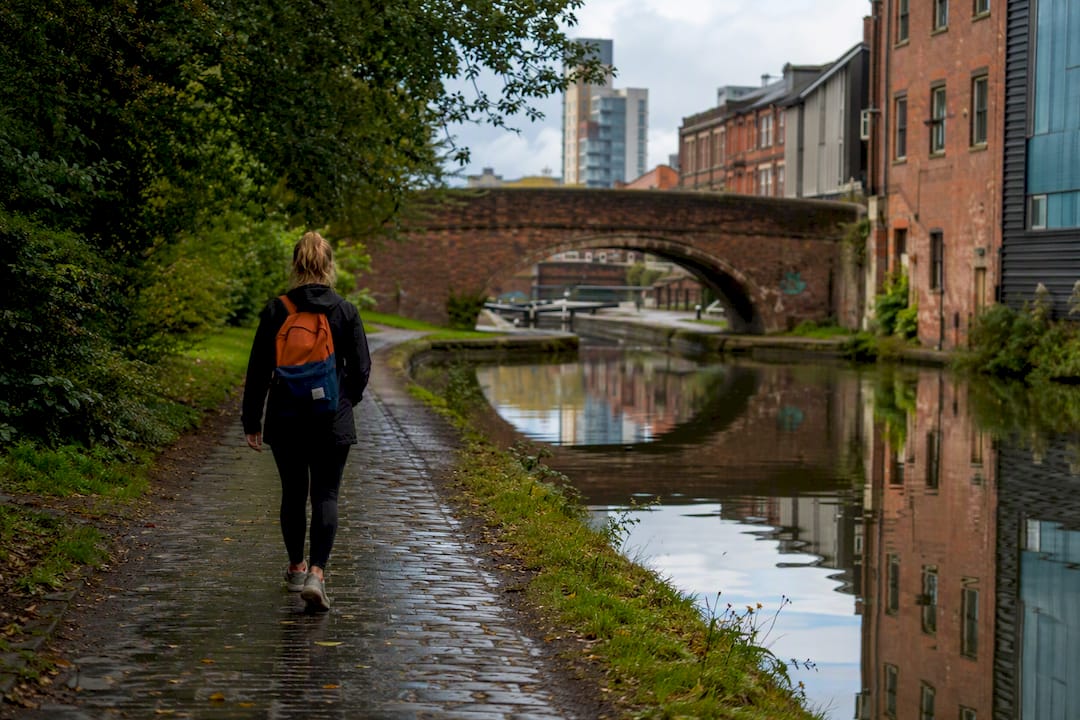
Birmingham holds an unusual claim: more miles of canal than Venice, threading through neighbourhoods that most visitors never associate with green space. Sutton Park, one of Europe’s largest urban parks, sits within the city boundary and offers genuine countryside walking without leaving town.
Manchester counters with Heaton Park, one of the largest municipal parks in the country, plus quick access to the Peak District, a genuine day-trip escape that few UK cities can match so easily.
Climate is where the two diverge most clearly. Met Office averages put Manchester’s annual rainfall at around 917mm against Birmingham’s roughly 757mm, a meaningful difference for anyone weighing outdoor lifestyle heavily, as LiveWhere’s climate data confirms. Commute times in both cities run comparably, though neighbourhood character varies sharply. Manchester’s suburbs skew toward Victorian terraces and converted mill housing, while Birmingham’s spread includes everything from Georgian squares to postwar new towns within its own boundary.
How do Manchester and Birmingham compare on safety and crime?
Crime comparisons between the two cities need careful handling, because raw totals almost always favour the smaller population without reflecting real risk. Global City Intelligence’s directional indicators suggest the two cities sit closer together on overall safety than popular perception implies, with meaningful variation appearing at neighbourhood level rather than city level.
Certain crime categories differ more than others. City centre theft and antisocial behaviour tend to cluster around nightlife districts in both cities, unsurprising given the density of evening footfall in Manchester’s Northern Quarter and Birmingham’s Broad Street. Violent crime patterns vary more by specific ward than by city as a whole.
The practical advice is the same wherever you’re considering: pull neighbourhood-level crime data before deciding, not city averages, and check time-of-day patterns if you’ll be commuting or socialising late. A street that feels calm at midday can carry a very different profile after dark, and that distinction rarely shows up in headline statistics.
Why do both cities call themselves the UK’s second city?
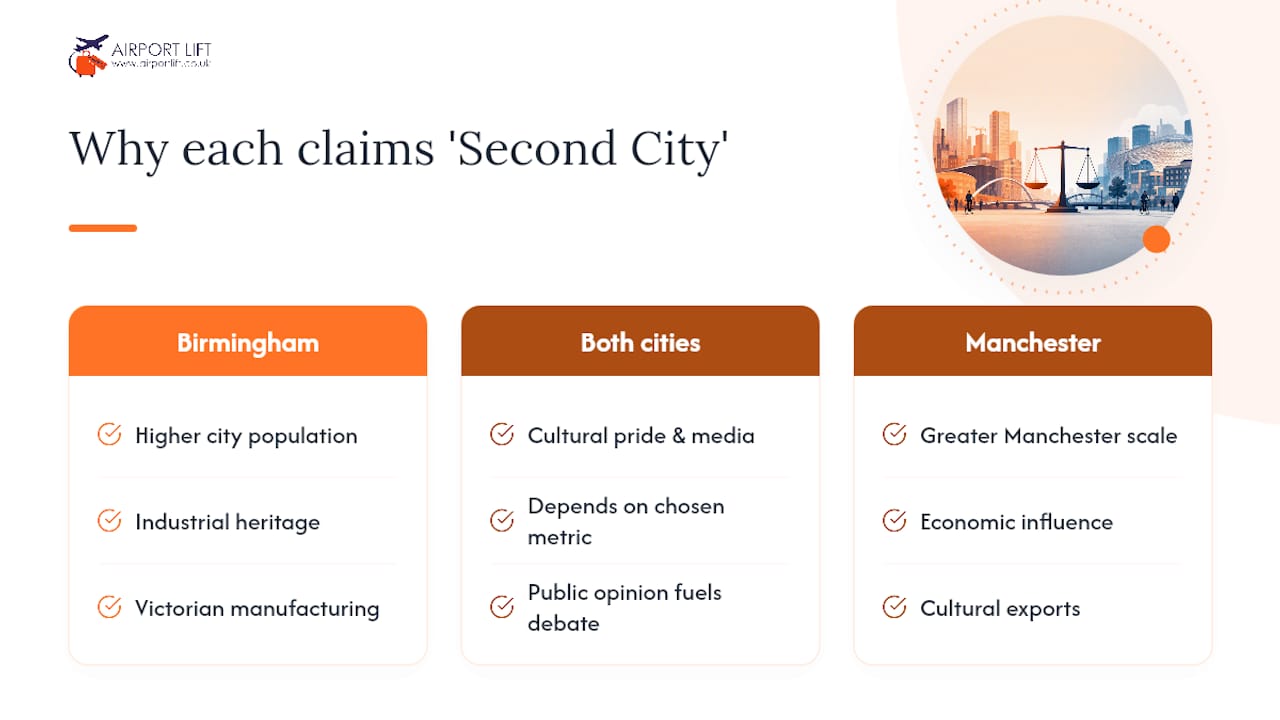
The “second city” argument has run for over a century, and it’s never been settled by a single agreed measure. Birmingham’s claim rests on population, its city-proper figure comfortably exceeding Manchester’s, plus historical industrial dominance during the 19th and early 20th centuries. Manchester’s claim rests on economic influence, cultural export and the sheer scale of Greater Manchester’s combined authority.
The Wikipedia entry documenting this debate traces how the label has shifted depending on which decade and which metric got applied, from Victorian-era manufacturing output to modern GVA figures and media coverage.
Public opinion keeps the argument alive largely through cultural pride rather than statistical rigour. Neither city’s residents show much sign of conceding the point, and national media coverage, football rivalries and regional identity all feed a debate that has less to do with facts and more to do with belonging.
The honest conclusion: “second city” is a cultural label, not a settled fact. Choose your metric and you can justify either answer, which tells you more about the term’s usefulness than either city’s actual standing.
How should you decide between Manchester and Birmingham?
Match the city to your actual priority rather than an abstract “which is better” question.
- Prioritise culture, music and creative or tech careers → Manchester is the stronger fit, particularly if you’re early career in digital, media or finance.
- Prioritise affordability and family space → Birmingham’s lower rents and broader housing stock make daily budgeting easier.
- Prioritise research and advanced manufacturing links → Birmingham’s industrial base and university partnerships carry an edge.
- Prioritise long-haul travel access → Manchester Airport’s route network is harder to beat from either city.
- Prioritise rail centrality → Birmingham’s position at the heart of the network wins for frequent intercity travel.
Before committing to either city, a short checklist helps validate the decision on the ground rather than on paper: visit both during a normal weekday, not just a weekend; check actual rental listings in your target neighbourhood rather than city averages; and trial the commute you’d actually do, at the time you’d actually do it.
Pro Tip: Spend a working Tuesday in your target neighbourhood, not a Saturday. Weekday rhythm, from morning commute crowding to evening quiet, tells you far more about daily life than a weekend visit ever will.
What are healthcare services like in Manchester and Birmingham?
Both cities sit within major NHS trust networks carrying regional and, in some specialisms, national significance. Manchester’s healthcare infrastructure centres on Manchester Royal Infirmary and the wider Manchester University NHS Foundation Trust, one of the largest trusts in the country, with strong specialist services in areas including cancer care and transplant medicine.
Birmingham’s healthcare provision runs through University Hospitals Birmingham, including the Queen Elizabeth Hospital Birmingham, which holds particular strength in trauma care given its role as a major receiving centre, alongside significant research partnerships tied to the University of Birmingham’s medical school.
GP capacity and waiting times fluctuate by borough in both cities rather than by city as a whole, following the same neighbourhood-variation pattern that applies to crime and cost of living. Anyone relocating for family reasons should check GP registration availability at the specific postcode level before signing a tenancy, since capacity can differ sharply between adjacent wards.
Specialist care access tends to favour whichever city hosts the relevant regional centre for a given condition, meaning the “better” city for healthcare genuinely depends on what care you or your family are most likely to need, not a general reputation either city holds.
What’s happening in the Manchester and Birmingham housing markets?
Manchester’s housing market has been shaped heavily by build-to-rent development over the past decade, with city centre towers adding density fast, particularly around Deansgate and the wider city centre core. That supply growth has kept pace with demand only partially, which helps explain why rent has climbed faster than Birmingham’s over recent years.
Birmingham’s housing story runs through its ongoing regeneration push, with major redevelopment around the city centre and infrastructure investment tied to improved transport links reshaping demand patterns across several districts. The city’s larger geographic footprint means new supply spreads across a wider area, which has helped keep average price growth steadier than in Manchester’s more concentrated core.
Both cities face the same underlying tension: strong demand from students, young professionals and inward investment against a housing supply that struggles to keep pace in the most desirable neighbourhoods. Anyone weighing a purchase or long tenancy should track planning applications in their target ward directly through the relevant local authority, since city-wide housing trend data smooths over exactly the street-level detail that determines whether a specific area is about to become significantly more expensive.
What are the must-see landmarks in Manchester and Birmingham?
Manchester’s landmark list runs through industrial heritage and modern reinvention side by side. The Museum of Science and Industry occupies part of the world’s oldest surviving railway station, while Manchester Cathedral and the John Rylands Library offer a quieter counterpoint to the city’s football and music reputation. Old Trafford and the Etihad Stadium function as landmarks in their own right for visiting fans.
Birmingham counters with the Bullring’s striking architecture, the Library of Birmingham’s distinctive facade, and the Birmingham Museum and Art Gallery’s Pre-Raphaelite collection, one of the finest outside London. The Jewellery Quarter adds a genuinely distinctive character found nowhere else in the country, still home to working goldsmiths and silversmiths trading from the same streets their trade has occupied for generations.

Neither city’s attraction list is an afterthought, and both reward a proper weekend rather than a rushed day trip.
How diverse are Manchester and Birmingham?
Both cities rank among the UK’s most ethnically diverse, though the pattern of that diversity differs. Birmingham’s demographic makeup includes long-established South Asian, Caribbean and increasingly diverse Eastern European communities, visible in areas like Sparkbrook and Handsworth, and reflected directly in the city’s food and cultural offering described earlier.
Manchester’s diversity runs through similarly established communities, particularly around Rusholme and Longsight, alongside a large and growing international student population that skews the city’s age profile younger than Birmingham’s overall average.
Both cities’ diversity shapes daily life meaningfully, from the range of cuisine available to the languages heard on any given high street, and neither should be treated as demographically uniform even within a single postcode.
Which sports teams define Manchester and Birmingham?
Football dominates both cities’ sporting identity, and Manchester’s rivalry between Manchester United and Manchester City ranks among the most-watched fixtures in world football. Both clubs’ women’s teams have also built substantial followings, illustrated by coverage such as BBC Sport’s tracking of Women’s Super League fixtures involving Manchester City.
Birmingham’s football scene centres on Birmingham City and Aston Villa, with the latter’s return to sustained Premier League form over recent seasons reviving a fixture list that carries genuine European ambition. Cricket also matters more in Birmingham than most outsiders realise, with Edgbaston hosting Test matches and major Ashes fixtures that draw crowds rivalling any football derby.
For anyone travelling in a group for match days or tournaments, group and family transfer options or minibus hire through Movable can simplify getting a full party to and from a stadium without the parking headache either city’s matchday traffic creates.
A note on how this guide was put together
This comparison draws on sourced city-level data rather than assumption, combining figures from LiveWhere’s 2026 cost of living comparison, Global City Intelligence’s directional indicators and Met Office climate averages, alongside transport data from East Midlands Railway. Population definitions were checked against the ongoing second city debate documented on Wikipedia.
Every figure carries a limitation: rents, house prices and even population boundaries shift, and neighbourhood-level variation within both cities is often wider than the city-to-city gap this guide reports. Treat every average here as a starting point for your own research, not a final answer.
This guide is published by a provider of fixed-price airport transfers serving travellers heading to Manchester Airport, Birmingham Airport and beyond, with licensed, DBS-checked drivers and flight tracking as standard. That’s the extent of the claim; the comparison above stands on its own sourced evidence, not on anything Airport Lift UK sells. If you spot a local detail that’s changed, particularly around rent or transport times, get in touch, since this guide gets revisited as fresher data becomes available.
Whichever city you’re weighing up, getting there reliably matters more than most people admit until they’ve missed a flight over a late taxi. Airport Lift UK runs fixed-price transfers to both Manchester Airport and Birmingham Airport from across Nottinghamshire and Derbyshire, with no hidden surge pricing and drivers tracking your flight so pickup times adjust automatically if you’re delayed. Whether you’re visiting to scout neighbourhoods before a move, travelling for business, or heading out with the family, you can book an airport taxi in minutes and know the price before you travel.
— AirportLift
Where to check the figures yourself
For population, employment and earnings data, the ONS publishes the primary UK statistics behind most city comparisons. The Met Office holds the authoritative climate records referenced throughout this guide. LiveWhere and Global City Intelligence both maintain live city-comparison tools worth revisiting periodically. For journey planning, check operator pages directly, including East Midlands Railway, and consult your target local council’s website for current council tax bands and planning applications.