
Oversized Luggage Taxi in the UK: Confirm Space and Fare in Writing

For skis, golf clubs, extra suitcases or a pushchair, an estate car or MPV is usually your safest bet, with a minibus for groups carrying several large bags. Whichever vehicle you choose, confirm the exact model, luggage allowance and total fare in writing before the day. We run larger vehicles alongside fixed-price quotes, so you can understand your options before you book.
TL;DR:
- A saloon typically holds two to three large suitcases, an estate three to four, and an MPV four to six, but passengers reduce available luggage space.
- Move up a vehicle class when you have more than three large suitcases, several bulky items, or at least five passengers traveling with luggage.
- Book minibuses 24–72 hours ahead, depending on local demand, and describe each bulky item by name rather than calling it extra luggage.
- Measure bags, including wheels and pockets, and give the operator their dimensions; count an oversized suitcase as roughly two standard bags.
- Request written confirmation of the vehicle, luggage allowance, and total fare, and disclose mobility aids with bulky luggage when booking.
Table of Contents
- Luggage capacity by vehicle type: saloon, estate, MPV and minibus
- UK rules, safety and disability duties that affect luggage carriage
- What to tell the operator when you book
- Item-by-item guidance for sports kit, instruments and bulky bags
- When to upgrade and how far ahead to prebook
- How to measure and describe your luggage accurately
- Packing large or fragile items so they travel safely
- Flight delays and how they affect your taxi booking
- Lessons from booking oversized luggage transfers
- Book an Airport Lift vehicle sized for your luggage
- FAQ
- Sources
Luggage capacity by vehicle type: saloon, estate, MPV and minibus
The vehicle class you book determines how much you can carry, and UK operators tend to describe capacity in similar terms. A standard saloon typically takes several large suitcases in the boot, while an estate, MPV or people carrier offers more space, and a minibus offers progressively more. These are planning figures used across the industry rather than fixed legal allowances, so always check with the operator before you travel.
Passenger numbers change the maths quickly. Five adults with cases will eat into boot space long before the case count alone would, because seats cannot fold down and bags often end up on laps or in footwells. If you are travelling as a group, our guide on booking the right taxi for five people walks through how to describe your party and luggage so the right vehicle turns up, and you can also consider Travel eSIM or airport SIM card: which should you choose? | WayfarerSIM to stay connected during your trip.
A few examples help put this in context:
- A couple with two large cases and two carry-ons fits comfortably into a saloon.
- A family of four with one large case each, plus a pushchair, usually needs an estate or MPV.
- A group of six heading to a ski resort with ski bags and holdalls will typically need a minibus.
Folding rear seats can sometimes free up extra space in an MPV, but this reduces passenger capacity, so it only works if your group is smaller than the seating allows.
Pro Tip: If you are travelling with a roofbox, trailer, or unusually bulky single item, mention it when you book. Not every vehicle in a fleet is fitted for one, and asking in advance saves a wasted journey.
UK rules, safety and disability duties that affect luggage carriage
Luggage policies in the UK are not just about convenience. The Department for Transport’s best-practice guidance for taxi and private hire licensing treats safe stowage as a safety matter, expecting drivers to help load luggage and mobility aids so passengers can exit the vehicle away from moving traffic. That framing matters when you are negotiating boot space for an extra case or a set of golf clubs: a driver may reasonably decline to overload a vehicle if it blocks visibility or a safe exit.
Wheelchair users have a separate and stronger legal footing. Guidance on access to taxis and private hire vehicles for disabled users confirms that designated vehicles must carry a passenger in their wheelchair and must not charge extra in covered circumstances, and licensing authorities are expected to publish details of each vehicle’s wheelchair capacity. This duty is set out in law under Section 36 of the relevant legislation, which places a direct obligation on drivers to carry wheelchair passengers without additional charge where it applies.
If your booking involves both a wheelchair or other mobility aid and oversized luggage, disclose both when you book. This gives the operator time to assign a vehicle that meets its legal duties on wheelchair carriage while still allowing for your bags.
What to tell the operator when you book
A quick phone call or message gets the right vehicle to your door, provided you give the operator enough detail to work with. Run through this checklist when you book:
- Confirm your exact pickup date and time, including any flight or sailing reference.
- State the full passenger count, including children and infant seats.
- Give the number of large suitcases and cabin bags, plus rough dimensions or weight for anything unusually large.
- Describe bulky items by name, such as “two ski bags” or “a full-size pushchair”, rather than lumping them in as “extra luggage”.
- Ask whether the driver can help load heavy items, and confirm meet-and-greet and flight tracking if you want them.
- Ask directly whether oversized or extra luggage carries a surcharge, so there are no surprises on the day.
- Request written confirmation, by text or e-mail, of the vehicle model, luggage allowance and total fare.
This matches the approach set out in best-practice guidance for licensing authorities, which recommends operators confirm vehicle assignment and fare clearly to avoid disputes, and that a larger vehicle be offered when the booked one is unlikely to cope.
Pro Tip: If the vehicle that arrives genuinely cannot fit your luggage safely, do not force it in. Ask the operator for an upgrade or a second vehicle, and keep your written confirmation to hand as evidence of what was agreed.
Item-by-item guidance for sports kit, instruments and bulky bags
Different items need different handling, and describing them accurately when you book makes the whole trip smoother.
- Golf clubs: a single golf bag usually fits in a saloon boot alongside one or two suitcases, but two bags often push you towards an estate or MPV.
- Skis and snowboards: ski bags are long rather than heavy, so an estate with folded rear seats or an MPV generally copes better than a saloon.
- Pushchairs: compact umbrella strollers fit most boots, but full-size pushchairs or travel systems often need the extra depth of an estate or MPV.
- Bicycles: these usually need a specific approach to fit safely; our bicycle booking checklist covers packing and the vehicles that work best.
- Musical instruments: anything larger than a guitar case, such as a cello or keyboard, should be flagged in advance so the driver can plan for it.
- Oversized suitcases: a single case over typical airline dimensions can take up the space of two standard bags, so count it accordingly when you book.
When in doubt, ask about roofboxes or a trailer rather than assuming an item will squeeze in.
When to upgrade and how far ahead to prebook
A few rules of thumb make the upgrade decision straightforward. Consider moving up a vehicle class when:
- You are carrying more than three large suitcases between your party.
- You have multiple bulky items, such as golf clubs and a travel cot, rather than just extra cases.
- Your group has five or more people travelling with luggage, not just passengers.
Minibuses and late-night pickups are worth booking further ahead, generally 24 to 72 hours depending on demand in your area, since fewer of these vehicles are on the road at any one time. Our guide on prebooking an airport taxi explains how locking in a fixed price early avoids last-minute surcharges, which tend to appear when operators have to scramble for a larger vehicle at short notice.
How to measure and describe your luggage accurately
Getting your dimensions right before you call saves time on both ends. Measure each case along its longest edges: height, width and depth, including wheels and any external pockets, since these often catch on boot openings even when the main body would fit. A kitchen tape measure or the retractable one in a sewing kit works fine for this.
Weigh bags on bathroom scales if you can, particularly if you are close to airline limits, since a heavy case can be as awkward to lift into a boot as a large one. For odd-shaped items such as golf bags or skis, measure the longest dimension rather than trying to estimate a volume, since length is usually what determines whether something fits diagonally across a boot or needs to lie flat.
When you pass this information to the operator, round up rather than down. Telling them a case is “about 75cm tall” when it is closer to 80cm risks a vehicle that is genuinely too small turning up on the day. Clear numbers, even approximate ones, help the operator match you to the right vehicle the first time.

Packing large or fragile items so they travel safely
Pack heavier items at the bottom of a case and fragile ones wrapped in clothing or soft items near the centre, away from the sides where knocks are most likely during loading. Hard-shell cases offer better protection for anything delicate, such as electronics or breakable souvenirs, than soft-sided bags that can flex under the weight of other luggage stacked on top.

For sports equipment, keep items in their proper bags or cases rather than loose. A ski bag or a padded golf bag is designed to protect the contents during handling and makes it far easier for a driver to load safely in confined boot space. Instruments should travel in hard cases where possible, strapped or wedged so they cannot shift during the journey.
If you are combining several fragile or bulky items, tell the operator so the loading order can be planned before you arrive, rather than worked out on the pavement. A driver who knows in advance that a case contains something delicate will usually load it last, so it comes out first and spends less time being moved around other bags.
Flight delays and how they affect your taxi booking
Flight delays change the practical picture for oversized luggage pickups, particularly for long-haul arrivals where baggage reclaim can take longer when a flight lands off its original schedule. If your transfer is booked with flight tracking, the pickup time adjusts automatically, which matters more for a minibus or MPV booking than a saloon, since larger vehicles are in shorter supply and harder to reshuffle at short notice.
Delays also affect how long luggage sits on a reclaim belt before you reach it, increasing the chance of cases arriving separated from a group or stacked awkwardly on a trolley. Building in extra time for reclaim, especially with bulky items like ski bags or golf clubs that often come out on an oversized belt, keeps your pickup realistic rather than rushed.
If your flight is delayed significantly, let your operator know as soon as you can, even with flight tracking in place, particularly if your booking involves a larger vehicle that needs to be reallocated from another job.
Lessons from booking oversized luggage transfers
The most common booking mistake we see is treating “extra luggage” as a single vague note rather than naming items specifically. A driver sent to collect “a family with luggage” has far less to work with than one briefed on “two adults, three large cases and a full-size pushchair”. We use flight tracking and meet-and-greet to take the guesswork out of timing, and fixed pricing means the fare agreed at booking is the fare paid on the day.
When you book, try phrasing it plainly: “four passengers, three large suitcases, one golf bag, need an estate or MPV.” That level of detail is what gets the right vehicle to your door first time.
— AirportLift
Book an Airport Lift vehicle sized for your luggage
Whether you need an estate for a couple of extra cases or a minibus for a group heading to the airport with golf clubs and ski bags, fixed-price transfers with no hidden fees or last-minute surcharges are available from some providers. Our group and family transfer options cover larger parties and bulkier luggage, and every driver is licensed and DBS-checked, with flight tracking and meet-and-greet available if you want someone waiting at arrivals.
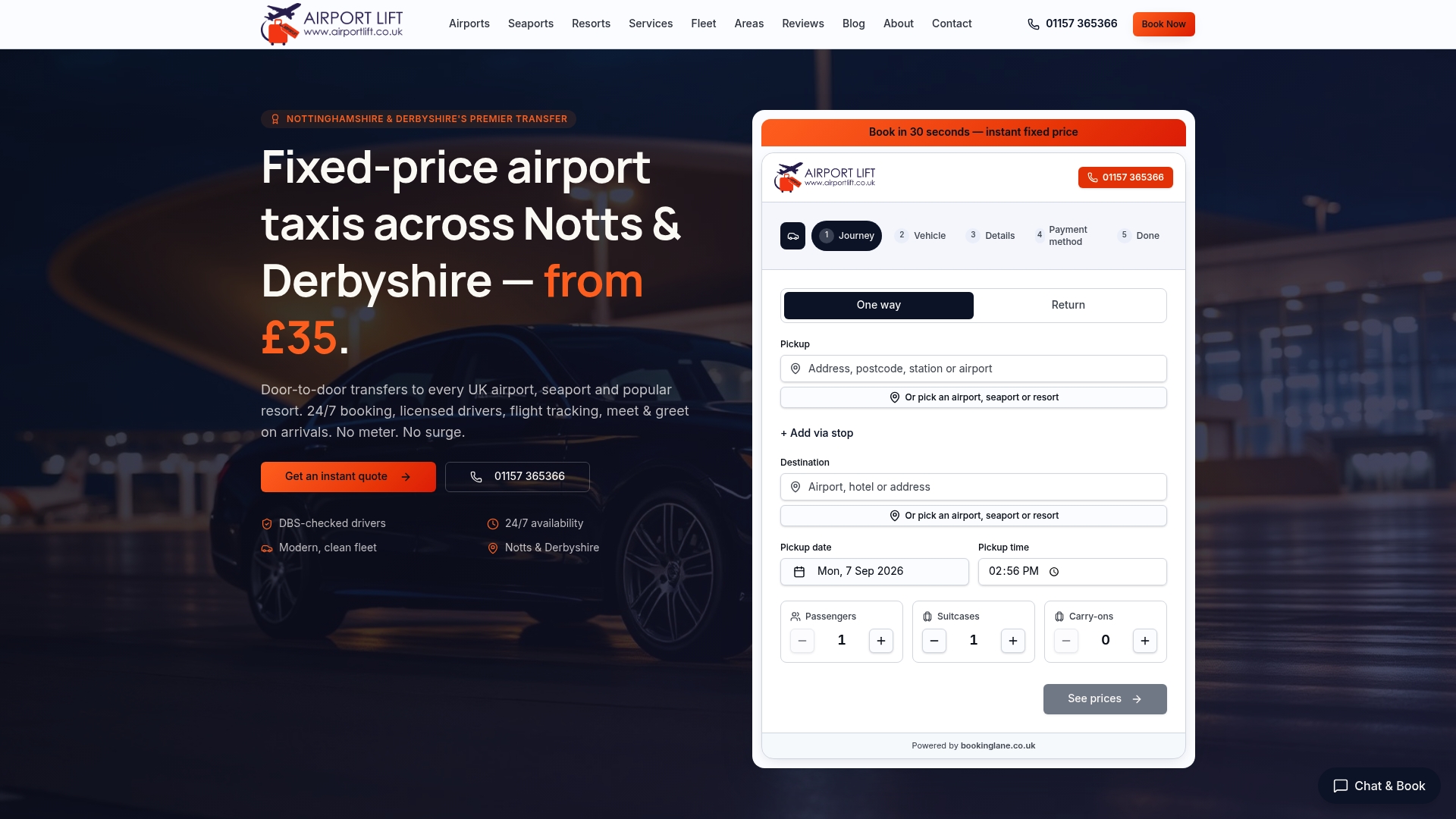
Once you know your passenger count and luggage, book your taxi and get an instant quote, and we will confirm the vehicle and total fare before you travel. If you are heading further afield, our resort and holiday transfer routes and seaport transfers are booked the same way, with the same fixed-price approach throughout.
FAQ
How many suitcases can a taxi fit?
A standard saloon typically fits around two to three large suitcases, with an estate managing three to four and an MPV around four to six, though these are indicative planning figures rather than guaranteed allowances. Always confirm your exact case count and sizes with the operator when you book so the right vehicle is sent.
What happens if my suitcase is over 23kg?
A heavy suitcase is more difficult to lift and load but does not usually change which taxi class you need, since boot space, not weight alone, determines fit. Mention the weight when you book so the driver can plan for extra lifting help if needed.
Can you fit 6 people in a black cab?
Standard black cab licensing and seating configurations vary by vehicle and city, so passenger capacity should be confirmed directly with the operator rather than assumed. For six people with luggage, an MPV or minibus booked in advance is generally the more reliable option.
Do taxis charge extra for luggage?
Some operators apply a surcharge for oversized or excess luggage, while others build this into a fixed quote, so it is worth asking directly when you book. Requesting written confirmation of the total fare, as recommended in best-practice licensing guidance, avoids disputes on the day.
Do I need to book a bigger vehicle in advance for a minibus?
Minibuses are in shorter supply than saloons or estates, so booking 24 to 72 hours ahead, depending on local demand, gives you a better chance of securing one at a fixed price. Last-minute minibus requests are more likely to come with limited availability or a higher fare.
Sources
These are the primary references behind the guidance above, useful if you want to check the detail yourself or need accessibility information for a specific booking.