
Avoid being stuck: Pay by card in UK taxis, TfL rule and checklist
Yes, you can pay by card in most UK taxis, and in London it is not optional. Every licensed black cab must accept card payment through a TfL-approved fixed terminal. Outside the capital, expect solid card acceptance in cities but real gaps in rural areas, so pre-booking through an operator such as Airport Lift remains the surest way to guarantee it.
TL;DR:
- Card payment acceptance in London taxis is mandatory and must be made through a fixed, built-in terminal; drivers cannot use personal phones or handheld devices.
- Outside London, urban fleets often accept cards voluntarily due to customer demand, but rural and independent operators may still prefer cash or lack reliable network coverage.
- If a card machine fails, passengers can try alternative cards, request the operator’s backup payment method, or opt to pay with cash and always request a receipt.
- Operators are legally prohibited from adding surcharges for card payments, and passengers should check that the fare matches the quoted amount on their receipt.
- Booking and paying upfront through apps or fixed-price services ensures payment certainty and avoids roadside payment issues in unfamiliar or remote areas.
Table of Contents
- Card payments in London: the TfL mandate and what it means for passengers
- What card acceptance looks like across the rest of the UK
- Common in-vehicle and app payment methods explained
- If the card machine fails or the driver can’t take card: step-by-step options for passengers
- Pricing, surcharges and receipts: the rules and what passengers should check
- Quick checklist: how to prepare to pay by card in a UK taxi
- How Airport Lift handles card payments and booking
- Where card payments in UK taxis are heading
- Book with confidence: fixed fares, paid upfront
- Sources
Card payments in London: the TfL mandate and what it means for passengers
London settled this question years ago. Since 31 October 2016, every licensed black cab in the capital has been required to accept credit, debit, and contactless payments, and from 1 January 2017 that requirement tightened further: the card terminal has to be a fixed unit built into the passenger compartment, not a driver’s personal phone or a loose handheld reader. This is a rule with teeth, and Transport for London’s own guidance sets out exactly what drivers must provide and what passengers are entitled to expect.
The mandate covers the major card networks. Visa, Mastercard, and American Express must all be accepted, and drivers cannot add a surcharge simply because you have tapped a card instead of handing over notes. That protection matters more than it sounds. Card surcharges used to be a quiet way for a small minority of drivers to claw back processing fees at the passenger’s expense, and TfL closed that loophole outright.
What happens if the machine does not work? TfL’s position is clear: drivers are expected to check their card device before starting work, and if it fails or is missing entirely, you are within your rights to look for another available taxi instead. A vehicle repeatedly found without a functioning, approved terminal can be marked “unfit” until the fault is corrected, which is a meaningful enforcement lever rather than a paper policy.
A few practical points worth carrying with you:
- The terminal must be fixed in the cab, not a driver’s mobile phone or a bolt-on handheld device.
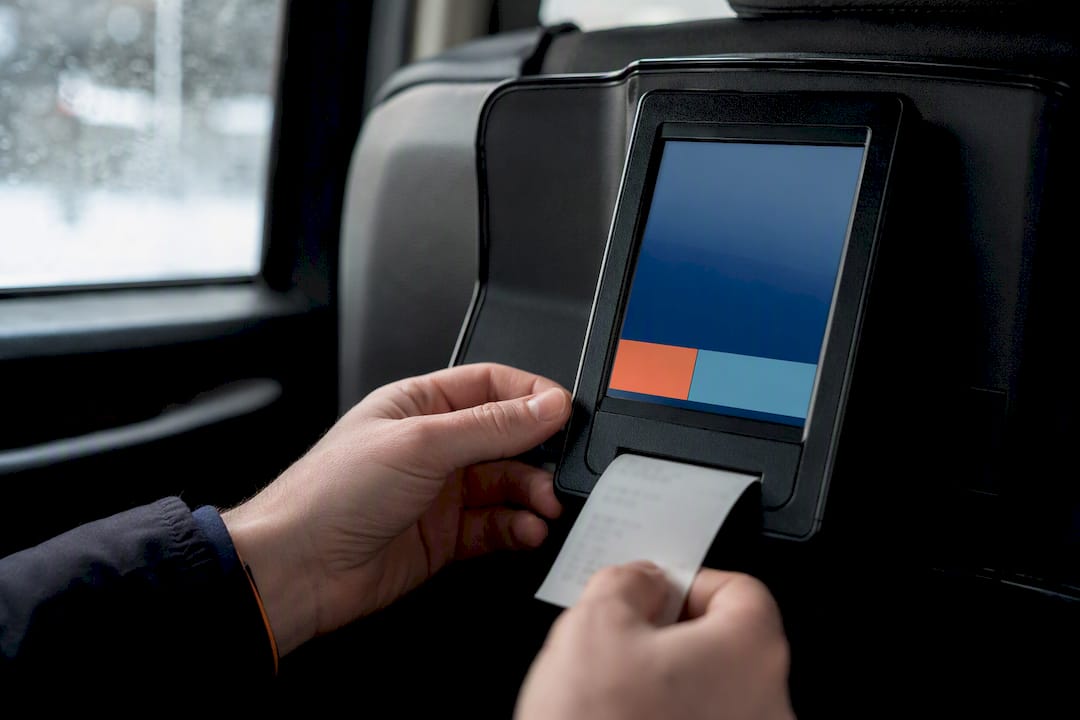
- You can ask for a printed receipt at any point, and the driver must provide one.
- No card surcharge is permitted for standard consumer cards.
- If the terminal is broken, you can choose to find another taxi rather than pay cash under pressure.
Here’s the key detail passengers often miss: a driver asking to enter your card details into their own phone in London is not just unusual, it is a breach of TfL rules. Drivers are explicitly told not to process card payments through personal devices, so treat that request as a warning sign rather than a workaround.
What card acceptance looks like across the rest of the UK
There is no single law forcing every taxi in England, Scotland, and Wales to take cards the way TfL forces London’s black cabs. That gap surprises a lot of travellers who assume the London rule is a national standard. It isn’t, and the difference shows up the moment you leave the capital.
City centres tend to behave a lot like London in practice, even without the legal mandate. Large taxi fleets in Manchester, Birmingham, Edinburgh, and similar hubs have adopted card terminals voluntarily because passenger demand for cashless payment made it commercially necessary. Major private-hire operators and app-based services have pushed this even further, since their entire booking model runs on stored card details rather than cash changing hands at the kerb.
Rural and independent operators are a different story. A single-vehicle firm covering a small market town has less commercial pressure to invest in card infrastructure, and network coverage in some rural spots is patchy enough that even a fitted terminal can drop out. Local licensing rules vary from council to council, and some authorities, Southampton among them, have introduced their own local requirements for card machines well ahead of any wider trend. Others have made no such move at all.
That patchwork means your experience genuinely depends on where you are standing when you hail a cab, not just which city you are in generally. A few things worth keeping in mind if you’re travelling outside London:
- City-centre taxi ranks and airport pickup points are the most reliable spots for card acceptance.
- Independent rural operators are more likely to expect cash, or to prefer it.
- Booking apps and operator websites almost always show accepted payment methods before you travel.
- Pre-booking with a fixed-price operator removes the guesswork entirely.
If payment certainty matters to you, more than the price or the route, book ahead rather than hailing on the street. A pre-booked transfer locks in the payment method at the point of reservation, which sidesteps the whole “does this cab take card” question before you’ve even left the house.
Common in-vehicle and app payment methods explained
Three payment routes cover almost every UK taxi journey: the fixed in-cab terminal, contactless or mobile wallet payment, and in-app prepayment. Each works slightly differently, and knowing what to expect from each one saves you an awkward moment at the end of the ride.
-
Fixed in-cab terminals. These sit mounted in the passenger compartment, usually within reach from the back seat, and are the only type of device London black cabs are permitted to use. You tap, insert, or swipe depending on the card, the driver confirms the fare on the meter or agreed price, and the terminal prints a receipt automatically or on request. For fares above the contactless limit, the terminal will prompt for a PIN, exactly as it would in a shop.
-
Contactless and mobile wallets. Apple Pay, Google Pay, and contactless debit or credit cards work on the same fixed terminals and behave the same way they do everywhere else. Most single-fare taxi journeys sit comfortably under the contactless spending limit, so a tap-and-go payment is the norm rather than the exception. Longer journeys, airport runs, or multi-passenger group fares sometimes exceed that limit, and the terminal will ask for a PIN rather than declining the payment outright.
-
In-app pre-payment. Booking through an operator’s app or website typically means the card is charged automatically once the journey is confirmed or completed, using details stored securely at booking. You get a digital receipt by email or in-app, rather than a paper slip handed over in the car. This method removes the in-vehicle payment step entirely, which is precisely why it suits airport transfers so well. Pre-authorised payment through an operator’s booking system means the fare is settled before you have even boarded, so there’s no fumbling for a card after a long-haul flight with a dying phone battery.
The practical difference between these three come down to when you commit to paying. A street-hailed black cab settles payment at the end, in the vehicle, using whichever card you happen to have on you. A pre-booked app transfer settles it before the journey starts, using a card stored on file. Neither is better in every situation, but if you’re arriving into an unfamiliar city, jet-lagged, with limited local currency, the certainty of having already paid tends to matter more than it sounds like it should.
If the card machine fails or the driver can’t take card: step-by-step options for passengers
Card failures happen, usually down to network coverage rather than anything the driver has done wrong. What matters is having a clear order of options rather than panicking at the roadside.
- Try an alternative card or mobile wallet first. A single failed transaction is often about that specific card, not the terminal, so a second card or Apple Pay/Google Pay attempt frequently succeeds where the first one didn’t.
- Ask whether the operator has a backup payment route. Some firms can process payment retrospectively through their booking system or app if the in-car terminal is down.
- Offer to find a cashpoint if you’re carrying no cash at all. This is the fallback of last resort, and a reasonable driver will usually accept a short detour to the nearest ATM.
- Request a printed or digital receipt regardless of how you eventually pay. This protects you if there’s any dispute later about the fare or the payment method used.
- Report a persistent problem to the operator, the local licensing authority, or TfL if you’re in London. A driver who repeatedly cannot process card payment when the vehicle should be equipped to do so is a compliance issue worth flagging.
Safety comes before payment logistics every time. If a disagreement over payment starts to feel uncomfortable, do not get out of the vehicle in an isolated spot to “sort it out,” and do not let a driver pressure you into leaving the car before you feel it’s safe to do so. TfL’s guidance for drivers experiencing device failures is explicit that they should tell passengers about the problem and offer alternatives, such as directing you to a nearby cashpoint, rather than putting you in an awkward position.
Pro Tip: Screenshot or photograph the driver’s licence badge and the vehicle registration before you even start the journey if you’re at all uneasy about the payment setup. It takes ten seconds, and it gives you something concrete to reference if you need to raise a complaint afterwards.
Pricing, surcharges and receipts: the rules and what passengers should check
The fare you’re quoted, whether metered or fixed, should be the fare you pay, with no card surcharge added on top. It is unlawful for operators to charge consumer cardholders extra purely for paying by card, a rule that closed a long-standing grey area in the taxi trade. Trading Standards can take action against operators who add these charges, so this isn’t a courtesy drivers are extending, it’s a legal baseline.
A valid receipt, whichever payment method you used, should include:
- The date and time of the journey.
- The metered fare or agreed fixed price.
- Any extras charged separately, such as luggage or waiting time.
- The total amount actually taken from your card.
Keep that receipt. It matters more than it seems in the moment, particularly if you’re claiming the fare back on expenses or if a dispute crops up later over the amount charged. A digital receipt from an app booking serves the same purpose and is arguably easier to keep track of than a paper slip that ends up crumpled in a coat pocket.
If you spot a surcharge you weren’t told about, or a fare that doesn’t match what was agreed, raise it with the operator directly first. Take a photo of the terminal screen showing the charge, hold onto the receipt, and note the driver’s licence number or vehicle registration. Most operators resolve genuine billing errors quickly once you can show exactly what happened, and if they don’t, Trading Standards or the local licensing authority is the next step.
Quick checklist: how to prepare to pay by card in a UK taxi
A few minutes of preparation before you travel removes almost every payment headache a UK taxi journey can throw at you.
- Check the operator’s website or app for accepted payment methods before you book or travel.
- Carry a second card as backup, plus a small amount of cash in case a terminal fails.
- Look for a “cards accepted” sign in the vehicle window if you’re hailing on the street rather than booking ahead.
- Ask for a printed receipt in London, or confirm your electronic receipt has arrived if you’ve booked through an app.
- Pre-book wherever payment certainty matters more than flexibility, particularly for airport runs or late-night journeys.
Pro Tip: If you’re travelling with a group and splitting the fare, agree who is paying before you get in the cab. A single card transaction is far easier for both you and the driver than trying to split a fare across four different cards at the terminal.
How Airport Lift handles card payments and booking
Some airport transfer services take payment online at the time of booking, which means the entire question of “will this taxi take my card” is settled before the journey even begins. Fares are fixed in advance, so there’s no meter running and no end-of-trip surprise, card-related or otherwise. Every airport transfer booking is confirmed with the price agreed upfront, alongside flight tracking so your driver adjusts to delays automatically, and meet-and-greet options for travellers who’d rather not navigate an unfamiliar arrivals hall alone.
For corporate travellers, invoicing removes the card-at-point-of-service question entirely, since billing runs on a monthly account rather than per-journey payment. That’s a genuinely different model from hailing a cab and hoping the terminal cooperates.
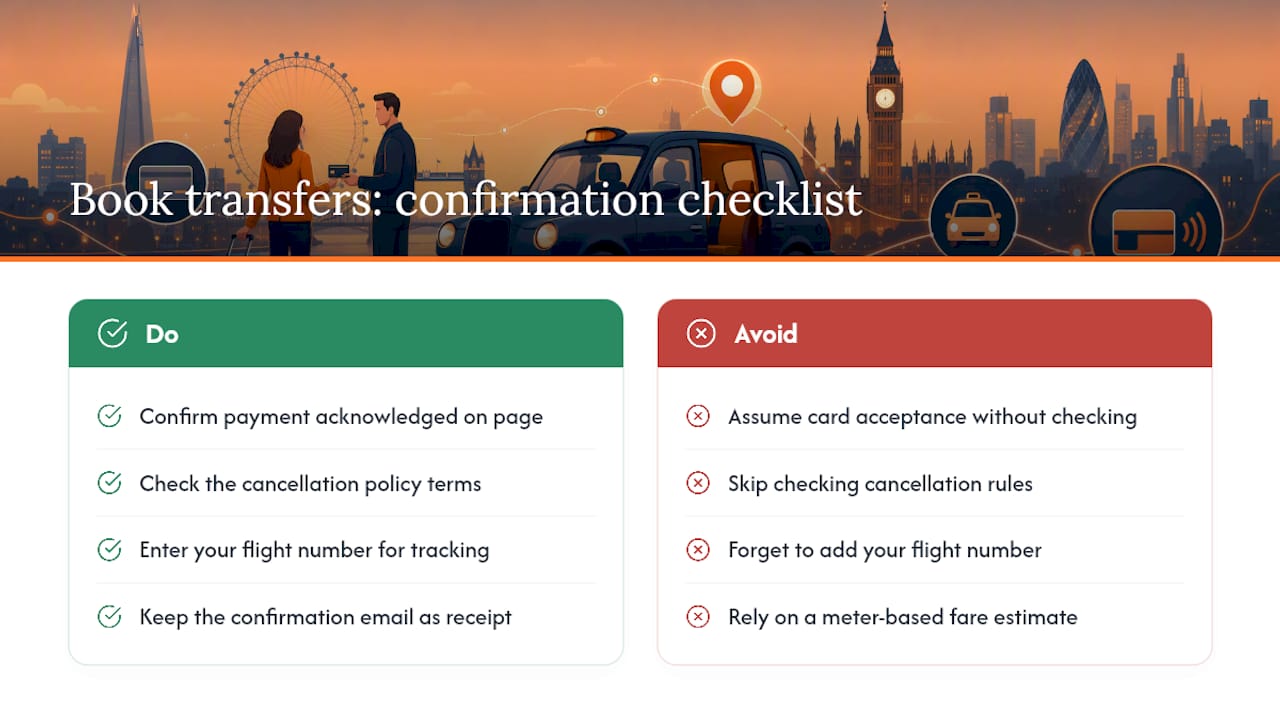
Booking ahead also gives you a paper trail without you having to ask for one. A confirmation email doubles as your receipt, showing the fare, the pickup details, and the payment taken, which is useful documentation to keep. When you book, it’s worth checking three things on the confirmation page: that payment has gone through and been acknowledged, what the cancellation policy allows if your plans change, and that your flight number has been entered correctly so tracking works as intended. Availability runs 24/7, which matters for early flights or delayed arrivals landing well outside normal taxi-rank hours.
Where card payments in UK taxis are heading
London got this right years before the rest of the country caught up, and the case for extending that model is stronger than most people realise. A fixed, approved terminal with a mandatory receipt does more than convenience; it removes the ambiguity that lets a small number of bad actors overcharge or mislead passengers who have no real way to argue back at the roadside.
Expect city fleets elsewhere in the UK to keep closing that gap voluntarily, driven by passenger expectation rather than legislation, in the same pattern Southampton and other councils have already followed. Rural and independent operators will lag behind for longer, simply because the commercial case for fitting expensive terminals is weaker where journeys are fewer and cash remains the local norm.
For travellers who genuinely cannot afford payment uncertainty, arriving after a long flight, managing a business schedule, coordinating a family with luggage, the honest advice is not to wait for the rest of the country to standardise. Book ahead with an operator who settles payment before you ever step into the vehicle. It’s a small habit that removes an entire category of travel stress, and it’s one worth adopting regardless of which city you land in.
— AirportLift
Book with confidence: fixed fares, paid upfront
Some airport transfer services offer fixed prices agreed and paid before you travel, so there’s no terminal to hunt for and no fare dispute to have at the end of a long journey. Such services confirm your fare, track your flight, and send a booking confirmation that doubles as your receipt, the same paper trail this guide has been telling you to keep. Drivers covering routes in local areas may offer meet-and-greet services and corporate invoicing for business accounts that need billing handled monthly rather than per trip.

Check availability and lock in your fare on the airport transfer booking page, where payment is confirmed at the point of reservation, not somewhere in the back of a cab.
Sources
- Accepting card payments - Transport for London
- Section 2: Payment for fares - Taxi Driver Handbook
- Do Taxis Take Cards? A Guide | Acorn Insurance