
A fixed-price airport transfer gives you the fare when you book, and that fare is the one you pay. A surge-priced or metered journey gives you an estimate, and the final figure depends on demand, time of day, traffic and waiting. For an early flight, a family with luggage or a business trip with no slack, the fixed fare is the safer choice. From Nottinghamshire and Derbyshire we quote it up front: for example, East Midlands Airport is £40 and Heathrow is £160.
TL;DR
- A fixed fare is agreed at booking. A surge or metered fare is worked out during or after the journey, so it can change.
- Private hire fares are not set by law. They are agreed between you and the operator, so the quote is the thing to check.
- Black cab fares follow a council-approved tariff, with higher rates at night and on bank holidays.
- A good quote states what is included: waiting time, flight delays, luggage, tolls and drop-off charges.
- Our fixed prices run from £40 to East Midlands Airport, with instant quotes at airportlift.co.uk/book.
Table of Contents
- What the difference means in practice
- How surge and metered fares are worked out
- What the law says about private hire fares
- Fixed fare or surge: which suits which journey
- Fixed prices from Nottinghamshire and Derbyshire
- A checklist for reading any transfer quote
- How to lock in a fixed fare
- Families, business travellers and bargain hunters
- Our view on price certainty
- Book your fixed fare
- FAQ
- Sources
What the difference means in practice
Fixed price: the operator quotes one figure for a defined journey, for example Nottingham to Manchester Airport. You see it before you commit. Traffic on the M1 does not change it.
Surge pricing: the fare rises when many people want a car at once and few are available. Rain, a concert, a train strike or a bank holiday morning are typical triggers. You are shown a higher figure, or a multiplier, at the moment you ask.
Metered pricing: the fare is built from distance and time. It is not surge pricing, but it shares the same weakness for a planner: you do not know the total until you arrive.

The three feel alike on a quiet Tuesday afternoon. They part ways at 4 am before a holiday weekend, in heavy rain, or when your flight lands late.
How surge and metered fares are worked out
It helps to know what moves a variable fare, because those are the moments a fixed fare protects you.
Demand and time of day
App-based services raise prices when requests outnumber nearby drivers. Published analyses of ride-hailing describe the multiplier as reacting to real-time supply and demand, and to outside signals such as weather. The pattern is predictable even if the figure is not: busy early mornings, wet weather and event nights.
Black cabs work differently. A council sets the tariff, and it rises by time. In Nottingham, the council’s approved hackney carriage tariff has a separate, higher night rate from 10 pm to 6 am and charges a fare and a half over Christmas and New Year. Statutory bank holidays carry their own surcharge as well. Early airport runs often fall into exactly these periods.
Distance, time and waiting
On a meter, time spent in traffic and waiting is charged as well as distance. The same tariff shows waiting billed by the second block, at hourly equivalents of £19 in the day and £21 at night (the rates in force from June 2022, so check the council page for the current table). A queue on the ring road can add to the bill in a way a flat quote cannot.
Extras that may appear
Variable fares tend to gather extras: airport drop-off or pick-up fees, waiting time, tolls, extra passengers or luggage and late-night supplements. A fixed quote should list which of these it covers. The checklist below shows how to read one.
What the law says about private hire fares
This is the point most travellers miss. Private hire is not metered or regulated in the way black cabs are.
TfL’s abstract of laws for private hire vehicles says no legislation gives anyone power to set private hire fares: they are a matter of negotiation between hirer and operator. That abstract also states that licensed private hire vehicles in London cannot carry a meter. It describes the London rules, so treat it as an illustration of how the system is built, not as the rule everywhere. Elsewhere in England, councils set the licence conditions, but the principle is the same: the East Riding council notes that private hire journeys have no set fare, so the fare should be confirmed when you book.
Two practical consequences follow:
- With a licensed private hire operator, the quote is the contract. Get it in writing, on a booking confirmation, with the pick-up point and destination named.
- Private hire must be pre-booked. Cambridge City Council warns that hailing a private hire vehicle on the street is illegal and the journey will not be insured, which is why a pre-booked confirmation matters.
A fixed fare is therefore not a special favour. It is the natural way for pre-booked private hire to work, and it is the clearest way to avoid arguing at the kerb.
Fixed fare or surge: which suits which journey
| Situation | Fixed fare | Surge or metered |
|---|---|---|
| Early morning flight, 3 to 6 am | Price known the night before | Night tariff or high demand can apply |
| Family of four with cases | One price, a vehicle sized to fit | Per-vehicle pricing and extras can multiply |
| Business trip with a tight schedule | Fare and pick-up time agreed in advance | Availability not guaranteed at peak |
| Bank holiday or Christmas week | Quoted figure holds | Holiday surcharges or surge apply |
| Long journey to Heathrow or Gatwick | Total known before you leave | Distance and traffic drive the total up |
| Short hop, no luggage, no time pressure | Still the simplest | Can be cheaper in quiet periods |
The last row is the honest one: on a quiet short trip the gap between the two is small. The more your journey depends on a fixed time, the more a fixed fare is worth.
Fixed prices from Nottinghamshire and Derbyshire
Here are the one-off fares we publish for the main airports, each fixed at booking:
| Airport | Fixed fare |
|---|---|
| East Midlands Airport | £40 |
| Leeds Bradford Airport | £70 |
| Birmingham Airport | £80 |
| Manchester Airport | £100 |
| London Luton | £120 |
| London Stansted | £130 |
| London Heathrow | £160 |
| London Gatwick | £170 |
The same logic applies beyond airports. A cruise departure is a fixed-time commitment: Southampton Cruise Port is £280, Liverpool Cruise Terminal £200 and Dover £355. For days out, Alton Towers is £55, Skegness and Ingoldmells £130, and Blackpool and Scarborough £200 each. All are on our airports, seaports and resorts pages.
For a longer read on how the maths works against a meter, see our guide to locking a fixed fare against a metered taxi and our note on how UK airport transfer prices compare.
A checklist for reading any transfer quote
Whatever you book, run through these points before you pay. They take two minutes. If you want a wider framework for what a transfer price should cover, this guide to planning private transfers covers the same ground for a different kind of journey.
- Is it one total? The quote should be a single figure for the whole journey, not a base fare plus items to be added later.
- Does it cover waiting time? Ask what happens if you are ten minutes late, or your flight lands late. Our service includes flight tracking, so the pick-up follows your arrival.
- Are airport fees stated? Some airports charge for drop-off or pick-up. Our guide to forecourt charges explains how they appear on a bill.
- Is the vehicle right for the group? An 8-seater for a family with luggage avoids a second car.
- What are the cancellation terms? They should be written down before you pay.
- Is the driver licensed? Our drivers are fully licensed and DBS-checked.
- Do you get a confirmation? A booking confirmation with the agreed price is your proof if anything is questioned later.
If a quote fails point one, you are looking at an estimate, not a fixed price.
How to lock in a fixed fare
Pre-booking is what makes a fixed fare possible. The steps are short.
- Choose the airport and the time. Work back from your check-in time. Our guide on calculating airport transfer timing shows a three-step method.
- Get the instant quote. Enter pick-up and destination on our booking page. The price shown is the price you pay.
- Add what you need. Group transport, an executive vehicle or meet and greet can be arranged on the same booking.
- Book ahead. Booking at least 24 hours before gives you time to plan. We take bookings 24/7.
- Keep the confirmation. It lists the agreed fare, pick-up and destination.
Families, business travellers and bargain hunters
Families. Children, car seats and several cases are where variable pricing hurts: a larger vehicle often costs more on a meter or in an app. Our group and family transfers use 8-seater minibuses, so everyone travels in one vehicle at one price.
Business travellers. What matters is arriving on time and being able to file one clear invoice. We offer executive vehicles, meet and greet and corporate account invoicing by monthly invoice. Our piece on when an executive car beats a standard taxi goes into the cost difference.

People looking for cheap transfers. Cheap should mean the lowest total, not the lowest headline. A low starting fare that grows with waiting time, night rates and extras is not cheap. A single known figure, from £40 to East Midlands Airport, lets you budget exactly. For a long journey, see how fixed fares work for long-distance taxis.
Our view on price certainty
We built Airport Lift around one idea: you should know your fare before you leave the house.
Travel is stressful enough. Early starts, luggage and a flight time that will not move all leave little room for a surprise on the bill. That is why every journey we publish has a fixed price, and why our quotes are instant, so you do not have to wait or negotiate.
Our drivers are fully licensed and DBS-checked. We track flights, so a delay does not leave you without a pick-up, and we offer meet and greet for those who want someone waiting at arrivals. Our booking line is open 24/7 because flights do not keep office hours.
The result is simple: no hidden fees, no surges, and a total you can plan around, whether you are travelling for work or for a holiday.
AirportLift
Book your fixed fare
If you are travelling from Nottingham, Mansfield, Hucknall, Ilkeston, Alfreton or anywhere else in Nottinghamshire and Derbyshire, you can see your price in seconds. We cover all UK airports, seaports and resorts, with fixed prices, licensed and DBS-checked drivers, flight tracking and 24/7 booking.
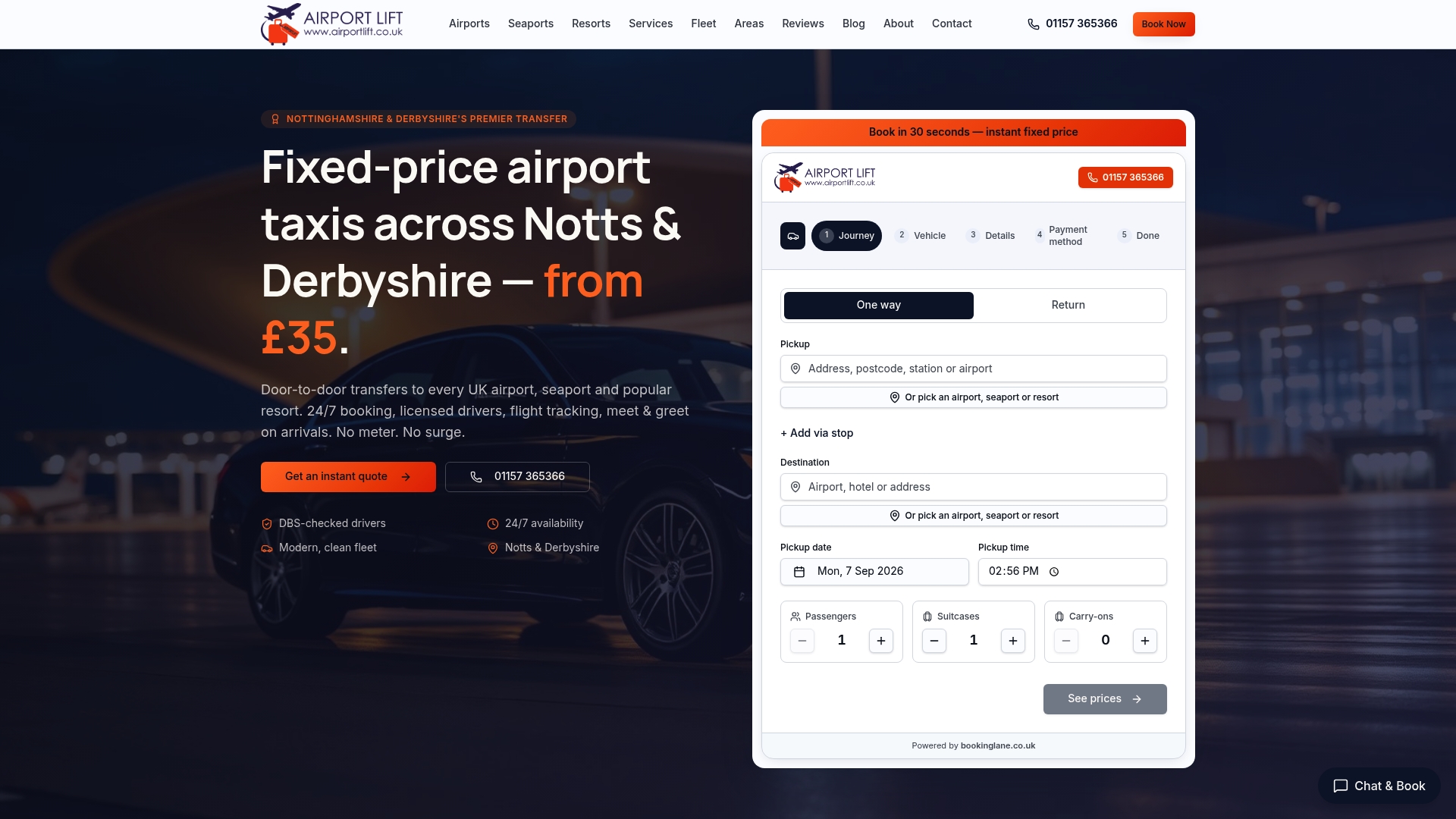
Get your instant quote on our booking page, or look through our airport transfer services.
FAQ
Is a fixed price always cheaper than a surge-priced taxi?
Not on every journey, because surge is only applied at busy times. The difference is certainty: a fixed fare cannot rise when demand does, at night or over a bank holiday. For early airport runs, which often fall in those periods, the fixed fare is the safer figure to plan around.
Can a private hire taxi charge whatever it likes?
Private hire fares are not set by legislation. TfL’s abstract of laws describes them as a matter of agreement between hirer and operator. That is why the quote, written on your booking confirmation, is the important document. Agree it before the journey, not after.
What can add to an airport transfer bill after booking?
On a metered or variable fare: waiting time, night or holiday tariffs, airport fees, tolls and extra passengers. On our fixed fares you are quoted a single price at booking. Check any provider’s quote for each of those items.
How far ahead should I book?
As early as you know your flight, and ideally at least 24 hours ahead. That gives you time to confirm the pick-up and check the booking. We accept bookings at any hour.
Sources
- TfL Taxi Driver Abstract of Law
- East Riding of Yorkshire Council: taxi licensing information for the general public
- Nottingham City Council: hackney carriage fares
- Cambridge City Council