
The safest taxi journey is one you have booked in advance with a licensed operator, where the driver, the car and the booking all match before you get in. That matters most on airport runs, which often start before dawn or end late at night, with luggage and tired legs. We are Airport Lift, and we take fixed-price airport transfers from Nottinghamshire and Derbyshire with licensed, DBS-checked drivers. This guide covers the checks that apply to any taxi in the UK, and how a prebooked transfer makes them easier.
TL;DR
- Book in advance with a licensed operator. Never get into an unbooked minicab: Police.uk warns there is no record of the journey and the vehicle will be uninsured.
- Before you get in, match the plate, vehicle and driver’s badge to your booking confirmation. If anything does not match, do not get in.
- Sit in the back, share your journey details with someone, and keep personal conversation to a minimum.
- If you feel uneasy, ask the driver to stop somewhere busy and get out. Call 999 in an emergency or 101 otherwise.
- A fixed price agreed at booking and a driver who is tracking your flight remove two common sources of pressure on an airport run.
Table of Contents
- Why women think harder about taxi safety
- Taxi or private hire: know which one you are getting
- Before the journey: a five-minute routine
- During the journey
- If something feels wrong
- Reporting a driver afterwards
- What licensing is meant to guarantee
- Airport trips: where the risks gather
- Our view
- Book a transfer you can plan around
- FAQ
- Sources
Why women think harder about taxi safety
Getting into a taxi means being alone in a small space with a stranger. A London Assembly review quoted a committee describing it as getting into somebody’s car, on your own with them, which is why licensing and booking records matter.
The feeling is common. A University of Central Lancashire study of 600 respondents found that 35% had felt unsafe in a taxi, including 40.4% of women and non-binary respondents against 20.6% of men. The most common triggers were a driver asking personal questions (47.3%) and not taking the usual route (24.6%).

The same study asked what would help. 72.0% wanted to check a driver’s licence number on a website and 50.8% wanted a number to ring during the journey. Both are easier when you have booked with an operator, because the booking gives you a name, a number and a record.
The great majority of journeys pass without incident. The routine below is about making the odds even better, and about knowing what to do if something feels wrong. The Suzy Lamplugh Trust describes such steps as a way to assess risk and alert others, not a guarantee.
Taxi or private hire: know which one you are getting
The two types work differently, and the difference is a safety point.
- Taxis (black cabs and hackney carriages) can be hailed on the street or taken from a rank in their licensed area.
- Private hire vehicles (minicabs) can only be pre-booked, according to GOV.UK. Both need a licence from the local council or Transport for London in the capital.
In practice, a car that pulls up and offers you a lift is not a private hire vehicle you can safely use. TfL says a minicab counts as unbooked if you approach the driver, the driver approaches you, or a bouncer takes you to it, even with a licence sticker. Our guide on how to spot licensed taxis and private hire goes through the plates and signs in more detail.
One London Assembly report found that taking an unlicensed minicab remains the greatest risk of cab-related sexual offences. Booking ahead removes that risk at the start.
Before the journey: a five-minute routine
1. Book ahead and keep the confirmation
Private hire operators must record the details of every booking, which makes a journey easier to trace if something happens. That record is the main thing an unbooked ride lacks. Ask the fare at the time of booking too, as Manchester City Council advises.
For airport trips, booking early also lets you lock in the price. Our guide to prebooking an airport taxi explains the timing.
2. Share the details
Send a friend or family member the plate, the driver’s name and your expected arrival time. The Institute of Licensing guidance, published by the Suzy Lamplugh Trust, suggests photographing the plate and sharing it with your expected arrival time.
3. Wait somewhere safe
If you are leaving a venue, ask the staff to book the taxi and wait inside until it arrives, as Manchester City Council suggests. At an airport, wait inside the terminal until your driver confirms they have arrived. Our guide to airport pickup points shows where drivers meet you.

4. Match the car and the driver
When the car arrives, check these against your booking:
- The rear licence plate shows the same make, model and registration as the vehicle, and there is an internal windscreen badge with the same details.
- The driver’s photo badge is visible. You can ask to see it, and Preston City Council says it is perfectly fine to photograph it.
- In London, TfL says confirmations include the plate, the driver’s first name, their licence number and a photo. If the car or driver does not match, do not get in.
- Ask the driver to confirm your name and destination before you give them. A driver who has been sent to collect you will know both, as NIDAS advises.
Plate colours vary by area. In Wolverhampton, for example, taxis have a green rear plate and private hire vehicles a yellow one. Check your own council’s rules, and use your licensing authority’s public register if you want to verify a licence. Preston’s register is one example.
During the journey
- Sit in the back, ideally behind the front passenger seat so you keep some distance from the driver. Sheffield City Council recommends the rear seats, ideally behind the driver.
- Keep conversation general. Personal questions were the biggest trigger of unease in the Lancashire study. You do not owe a driver your address, your plans or your relationship status.
- Keep your phone charged and in reach. Follow the route on a map if it helps you feel settled.
- Pay in a way you control. Our guide to paying by card in UK taxis covers what to expect.
If something feels wrong
Trust your instincts. Both Sheffield City Council and the Suzy Lamplugh Trust say that if you feel worried, you should ask the driver to stop in a busy area and get out. Self-defence instructor Dene Josham told the Telegraph that it is always acceptable to ask a driver to pull over, and he suggests having an excuse ready, such as saying you feel sick, if asking directly feels unsafe.
If you booked through an operator, you can also ring them. The same Telegraph piece describes passengers whose group called the taxi firm and the dispatcher told the driver to stop.
If you feel unsafe, text a friend or family member and ask them to call the police. Call 999 if a crime is taking place or there is a threat to life. For non-emergencies, call 101.
Reporting a driver afterwards
Report sexual harassment (staring, touching, exposing, catcalling) to the police on 101, or online through the Met Police website in London, as TfL directs. Dangerous driving, assault or theft should go to the police, and unsafe driving, abusive behaviour or deliberately long routes to inflate the fare should go to the licensing authority. Somerset Council’s list is typical.
A complaint creates a record and an officer investigates. If the allegation is proven, the council can issue warnings, suspend or revoke the licence, or prosecute. Unlicensed vehicles can be reported through GOV.UK.
What licensing is meant to guarantee
The national statutory taxi and private hire standards require licensing authorities to provide safeguarding guidance and to require drivers to take safeguarding training, so they can recognise vulnerable passengers and report concerns.
Drivers are also vetted. One council policy adopted in April 2025 requires an Enhanced DBS disclosure less than three months old for all driver applicants, and says all convictions must be disclosed. Requirements differ by council, but the principle is the same: a licensed driver has been checked, and an unlicensed one has not.
Airport trips: where the risks gather
Airport journeys have their own pressures: early starts, late arrivals, heavy bags, unfamiliar terminals and people approaching you offering a lift. A few habits help.
- Never accept an offer in the arrivals hall. Touts approach tired travellers. An approach by a driver means the ride is unbooked.
- Prebook the return as well as the outward leg. Manchester City Council advises pre-booking your return vehicle before you go out. After a delayed flight at midnight, the last thing you want is to improvise.
- Know the price before you leave. A fixed fare means no meter running on a long route and no argument at the kerb. See our comparison of an airport taxi queue against prebooking.
- Sort luggage in advance. If you have bulky bags, confirm space and fare in writing so nobody is hunting for a bigger car on the kerb.
Our view
Safety on a taxi journey comes from certainty: you know who is coming, what the car is, what it costs and where it is going. Every step in this guide is a way of replacing a guess with a fact.
That is why we work the way we do. Our drivers are fully licensed and DBS-checked. Prices are fixed at booking with no hidden fees or surges, so there is no fare to argue about halfway through a journey. We track your flight, so a delay does not leave you waiting at the kerb for someone to turn up, and our meet-and-greet service puts a driver where you can see them on arrival. You can book at any hour, 24/7, so a late return does not have to be left to chance.
If you travel alone, for work or for a holiday, the routine in this guide takes a few minutes. Our aim is that the booking confirmation gives you everything you need to complete it.
AirportLift
Book a transfer you can plan around
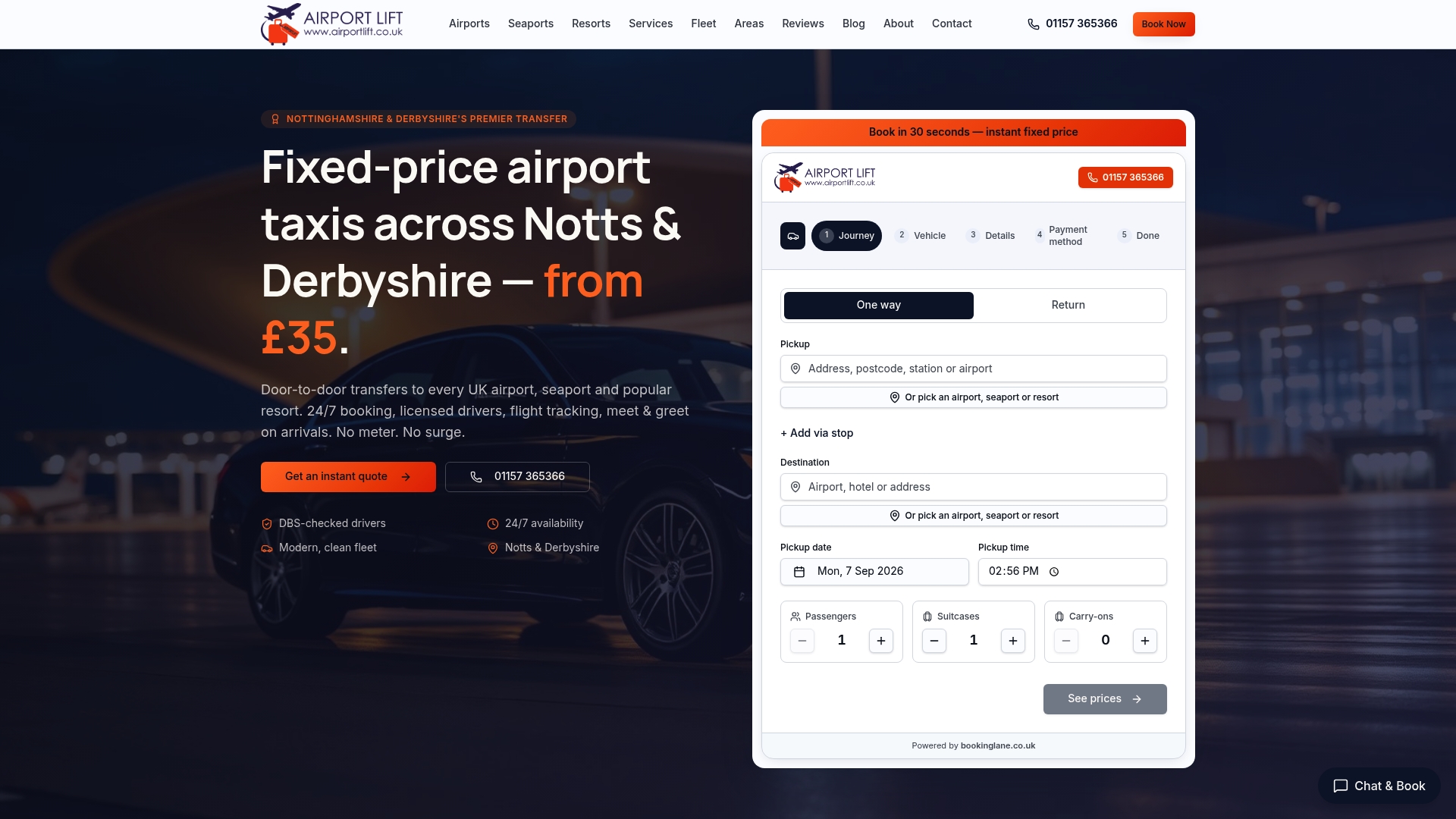
We provide fixed-price transfers from Nottinghamshire and Derbyshire to all UK airports, seaports and resorts. Published prices include £35 to East Midlands Airport, £75 to Birmingham, £100 to Manchester, £160 to London Heathrow and £170 to London Gatwick. You can see every airport fare on our airport transfers page, or get an instant quote on the booking page. If you want a driver waiting for you on arrival, see our meet and greet service.
For business travel, we offer executive vehicles and corporate account invoicing. Families and groups can use our 8-seater minibuses through group and family transfers.
FAQ
Is it safer to book a taxi in advance?
Yes. Police.uk explains that a booked minicab means a licensed, insured driver and vehicle with a logged record of the journey. An unbooked one carries no such record and is uninsured. Our guide on prebooked taxis against on-demand rides sets out the difference.
Should I sit in the front or the back?
The back. Councils such as Sheffield advise sitting in the rear, ideally behind the driver. It gives you distance and an exit on either side.
What should I do if the driver takes a different route?
Ask calmly where they are going. If you are not reassured, ask them to stop somewhere busy and get out, or ring the operator. Deliberately long routes to inflate a fare can be reported to the licensing authority, and in an emergency you should call 999.
Can I ask for a woman driver?
Some smaller services run by female drivers exist around the country, and some passengers prefer them. We cannot promise a driver of a particular gender, so it is best to speak to us when you book about what would make you feel comfortable.
Sources
- Safer travel, Transport for London
- Travel safe, Police.uk
- How to stay safe in a taxi, Sheffield City Council
- Safer travel in our taxis and private hire vehicles, Manchester City Council
- Taxi safety, Hinckley & Bosworth Borough Council
- Taxi passenger safety guidance, Preston City Council
- Get Home Safe, City of Wolverhampton Council
- Advice for taxi passengers, Somerset Council
- Transport Safety, Suzy Lamplugh Trust
- Institute of Licensing steps for using taxis, Suzy Lamplugh Trust
- Taking a taxi?, NIDAS
- Report unlicensed taxis, minicabs or private hire vehicles, GOV.UK
- Statutory taxi and private hire vehicle standards, GOV.UK
- Taxi and Private Hire Licensing Policy, North Hertfordshire Council
- Crime on public transport, London Assembly
- Safety in Taxis Study, University of Central Lancashire
- How getting a taxi became so unsafe, The Telegraph