

Yes, you can add an extra stop to an airport transfer, and the way to do it without a surprise on the fare is to agree the stop before the journey, not at the kerb. Name every pick-up and drop-off when you ask for your quote, so the price you are given covers the whole route. A fixed price only protects you if it was set for the journey you actually take.
This guide is for people travelling from Nottinghamshire and Derbyshire who want to collect a friend, drop a child at a relative’s, pick up a colleague or call at a hotel on the way to the airport. It explains what counts as a stop, what changes the price, how to word your booking and how much time to build in.
TL;DR
- Extra stops are normal on a pre-booked private transfer, but they should be requested when you book, with the full address of each one.
- A stop can change the route, the journey time and the waiting time, so the quote needs to be based on the complete journey.
- A stop is not the same as a wait: a quick pick-up is one thing, a 20-minute errand is another, and both should be agreed in advance.
- Our transfers are fixed price with no hidden fees or surges, which is why we want the whole route in front of us before you confirm.
- Add time for each stop, then check the rest of your timing against our airport transfer timing guide.
Table of Contents
- What counts as an extra stop
- Why the stop has to be agreed before you travel
- How to ask for an extra stop: a step-by-step routine
- What changes the price of a journey with a stop
- A stop on the way, or a detour? Three worked examples
- Extra stops on the return journey
- How much extra time to allow
- Business travellers and corporate accounts
- Planning a multi-stop trip in a different setting
- Perspective
- Book a journey with stops
- FAQ
- Sources
What counts as an extra stop
An airport transfer is normally a single journey from one address to one airport terminal. Anything that adds a place to that journey is an extra stop. In practice, readers ask about four kinds:
- An extra pick-up: a second passenger joining at a different address, such as a friend two streets away, a colleague in Hucknall or a grandparent in Ilkeston.
- An extra drop-off: leaving someone or something on the way, such as a child at school or a family member at a station.
- A short call: a cash machine, a pharmacy, a key hand-over or a locked-up office.
- A change of terminal or airport: one group flying from Terminal 1, another from Terminal 2, or two people flying from different airports on the same day.
The first two are the easiest to price, because they are simple additions to the route. The short call is where most disagreements come from, because it involves time as well as distance. The last needs the most planning and is covered further down.
Why the stop has to be agreed before you travel
Private hire is built on a booking. The journey, the vehicle and the price are agreed first, and the driver is dispatched against that booking. When a stop is added on the day, the driver has to decide whether it fits the schedule for the next job, whether the vehicle can reach the address, and whether the fare still makes sense. Nobody enjoys making those decisions on a pavement at 4am.
There is also a practical rule of the road. The Taxi Driver Handbook explains that licensed drivers may set down and pick up on single and double red and yellow lines, in most parking bays and in bus lanes, but must not wait where restrictions apply. It also says there is no fixed time limit for stopping, only the time needed for passengers to get in or out, including securing a wheelchair. In plain terms, a quick pick-up at a kerb is straightforward, while a stop that needs the car to sit and wait depends on where it is. That is why the address of every stop matters: the driver can plan where to pull in.
If you tell us at the time of booking, the stop becomes part of the plan, not a favour asked in a hurry.
How to ask for an extra stop: a step-by-step routine
This is the routine that keeps the price clear and the timing realistic.

Step 1: List the journey in order
Write out the route as a sequence before you open the booking form. For example: home in Mansfield, then a friend in Sutton-in-Ashfield, then East Midlands Airport. Order matters, because the same three places visited in a different order can mean a different distance.
Step 2: Use full addresses and postcodes
“Near the church” is not an address. Give the house number, street and postcode for every stop. Where the entrance is awkward, such as a gated drive, a flat with a shared door or a cul-de-sac with parking limits, say so. The driver can then decide where to stop safely, which matters given the stopping rules above.
Step 3: Say who gets in or out and what they are carrying
A stop changes the passenger count and the luggage count. Two people with two suitcases each is a different job from two people with hand luggage. If anyone is joining with a child seat need, bulky sports kit or a large case, say so up front. Our guide to oversized luggage in a taxi shows why confirming space in writing is worth doing, and the same principle applies to a second pick-up.
Step 4: Say how long the stop will take
Be honest. A hand-over at the door is two minutes. A friend who is “nearly ready” is ten. If you need the car to wait while you do something, say that too. Our article on airport pickup waiting time explains what is normally included and what can cost extra, which is a useful read before you decide how long to ask for.
Step 5: Get the quote for the whole route
Use the online booking page to get an instant quote, and include the stops in your request. Our prices are fixed, with no hidden fees or surges, so what matters is that the price you confirm is for the journey you will actually take.
Step 6: Check the confirmation
When the booking confirmation arrives, read it as you would a boarding pass. Are all the addresses there? Is the pick-up time right? Is the number of passengers right? If anything is missing, say so before the day, not on it.
What changes the price of a journey with a stop
The fare for a journey with a stop is shaped by a handful of things. None of them is mysterious, but they add up.
| Factor | Why it matters |
|---|---|
| Extra distance | A stop that sends the car away from the direct route adds miles. A stop already on the way adds very little. |
| Extra time | Every pick-up takes minutes at the door, and traffic can add more. |
| Waiting | If the car must wait for you, that is time the driver cannot spend elsewhere. |
| Passengers and luggage | A larger party or more bags can need a bigger vehicle, such as an 8-seater minibus. |
| Time of day | An early or late pick-up can be harder to plan around than a daytime one. |
The base price of a transfer is the fixed starting point. These are our published one-off prices from Nottinghamshire and Derbyshire, read from our site in September 2026:
| Destination | Fixed price |
|---|---|
| East Midlands Airport | £35 |
| Leeds Bradford Airport | £70 |
| Birmingham Airport | £75 |
| Manchester Airport | £100 |
| London Luton | £120 |
| London Stansted | £130 |
| London Heathrow | £160 |
| London Gatwick | £170 |
The full list, including seaports and resorts, is on our airport transfers page. For a trip with a stop, the right question is not “what is the base price” but “what is the price for this exact route”. Ask for that, and keep the answer in writing.
Why a fixed price helps when you add a stop
With a metered taxi, a stop means the meter keeps running while the car sits at the kerb, and you cannot know the total until you arrive. A fixed fare removes that uncertainty. We explain the difference in our guide to fixed price versus metered taxis. The same logic applies at the airport itself: forecourt charges can catch out people who add a last-minute stop, and our pages on airport drop-off charges and UK airport transfer prices show what to look for.
A stop on the way, or a detour? Three worked examples
Examples make the difference clearer. These are illustrations of how to think about a route, not quotes.
Example 1: A friend on the way to East Midlands Airport
You live in Kimberley and a friend lives in Eastwood, which is roughly in the direction of the airport. The stop adds a few minutes at the door and little extra distance. Give both addresses, say two passengers and the number of bags, and ask for the price for the full route. This is the simplest kind of stop.
Example 2: A relative in the opposite direction
You are heading to Manchester Airport from Alfreton, but a relative lives somewhere that sends the car away from the route. Here the distance matters more than the minutes. Ask for the quote with the relative’s address included, and compare it with the plan where they travel separately. Do the sum before you decide, not after.
Example 3: A family with a hotel call on the way home
A family of six lands at Birmingham Airport and wants to call at a relative’s house on the way back before going home to Nottingham. Six people with luggage need more than a standard saloon, so the vehicle choice is part of the booking. This is where our 8-seater minibuses for groups and families come in. Tell us the party size, the bags and the stop, and plan the arrival time around the call as well as the flight.
Extra stops on the return journey
The return leg is harder to plan, because you do not know exactly when you will be through the terminal. Flight tracking helps here: we track your flight, so a late arrival does not leave a driver waiting at the wrong time. If you want a stop on the way home, put it in the booking from the start, and give the driver a realistic idea of how long you will be.
Pick-up arrangements at the terminal also matter. If you are meeting someone at the airport as well as collecting luggage, our meet and greet service means your driver is waiting for you, and our guide to finding your driver at UK airports explains where pick-up points tend to be. If a second passenger is joining you in the arrivals hall, tell the driver their name and flight so everyone ends up in the same place.
How much extra time to allow
The most common mistake with a stop is allowing the distance but not the time. Two minutes on the map becomes ten at the door, especially with luggage, children or an unlocked-but-not-ready friend.
A sensible approach:
- Work out your normal journey time to the airport and the time you want to be there. Our guide to calculating airport transfer timing walks through the steps.
- Add a buffer for each stop. Be generous for a pick-up where people need to load bags.
- Add a margin for traffic. Busy roads, school-run times and roadworks all move the arrival time.
- Move the pick-up earlier by the total, not later.
- Book early enough that the plan is settled. Our when to book an airport taxi guide covers the timing.
If the stop is on the way out, an earlier start costs you very little. If it is on the way home, the risk is only tiredness, not a missed flight, so you can be more relaxed. Either way, the point is that the schedule is built round the stop, not squeezed to fit it.
Business travellers and corporate accounts
For business travel, stops are routine: a colleague from another office, a client’s hotel, a late sign-off at the workplace. The difficulty is not the stop but the paperwork. If you travel often, a single account can keep it straightforward. We offer corporate account invoicing, with payment by monthly invoice instead of at each booking, and our executive travel vehicles are available for those who want a more formal arrival. Put every passenger and stop into the booking and the invoice reflects the journey actually made.
Planning a multi-stop trip in a different setting
Stops matter just as much when travelling abroad. If you are planning a trip where the route, the hours and the number of stops shape the whole fare, the same principle holds: the more you fix in advance, the fewer surprises. For a worked look at how route and hours move a quote, see this piece on how route and hours change a private driver quote. The idea carries straight over to a UK airport run.
Perspective
Most of the trouble we hear about with stops comes from the same place: the stop was decided late. A passenger remembers a parcel, a friend, a house key, and the plan changes at the door.
Our approach is simple. We price transfers at a fixed fare, with no hidden fees and no surges, and we want that promise to hold for your whole journey. That is why we would rather know every address at the start. A fixed price is only as useful as the route it was built on.
Our drivers are licensed and DBS-checked, we track your flight, and we are available 24 hours a day, so a plan with a stop in it is not a problem. It is just a plan we would like to see in full.
AirportLift
Book a journey with stops
We provide fixed-price airport transfers across Nottinghamshire and Derbyshire, with licensed, DBS-checked drivers, flight tracking, meet and greet, executive vehicles and 8-seater minibuses for groups and families. Booking is available 24 hours a day.
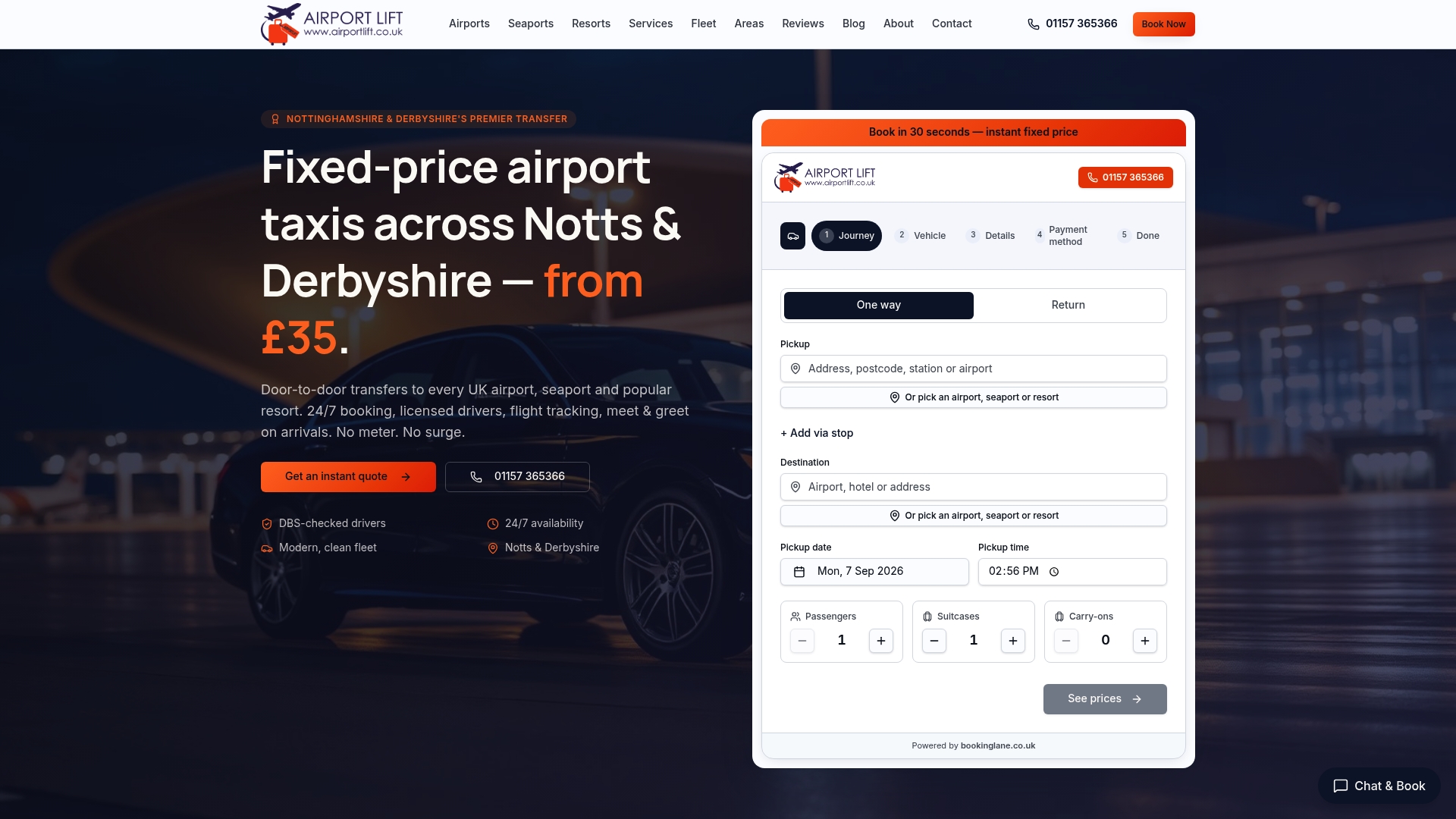
Get an instant quote on our booking page, and list your stops when you do. For a first look at destinations and prices, see our airport transfers page, or our services page for executive and group travel.
FAQ
Can I add an extra stop to my airport transfer?
Yes. Extra stops are normal on a pre-booked private transfer. Give the full address of each stop when you request your quote, so the price and the timing are planned for the whole route.
Will an extra stop change the price?
It can, because a stop may add distance, time or waiting. That is why the quote should cover the complete journey. Our prices are fixed with no hidden fees or surges, so the figure you confirm is the one that applies to that route.
Can I ask the driver to stop on the day?
It is better to arrange it in advance. A stop requested on the day has to fit the driver’s schedule and the place you choose, and drivers may only stop where the rules allow, as the Taxi Driver Handbook explains. Booking it ahead removes the guesswork.
How long should I allow for a stop?
Allow more than you think. A quick hand-over takes a few minutes, while collecting a passenger with luggage takes longer. Add the time for each stop to your normal journey time, plus a traffic margin, and move your pick-up earlier by that total.
What if my group is too big for a standard car?
Tell us the number of passengers and bags when you book. We offer 8-seater minibuses for groups and families, so the vehicle can be matched to the party, including any passenger joining at a second address.