

A ground transportation policy works when every journey is booked in advance, priced before it starts and backed by paperwork that reaches finance without chasing. Fixed-price pre-booked transfers on a monthly invoice account meet all three. A street taxi with a meter and a card slip meets none of them. This guide sets out what a UK business should write into the ground transport section of its travel policy, and why the booking method matters as much as the wording.
TL;DR
- Define ground transport in the policy by type: taxis and private hire, minibuses, executive cars, hire cars, rail and employees’ own vehicles.
- Require pre-booking at a fixed price, so the cost is approved before the journey and cannot surge on the day.
- HMRC expects you to record the date, purpose and details of every expense and to keep receipts. Employers keep records for 3 years after the relevant tax year.
- A monthly invoice account replaces a pile of individual receipts with one document that finance can match against bookings.
- Set clear rules for late-night taxis, mileage and group travel so managers approve consistently.
Table of Contents
- What ground transportation covers in a business travel policy
- Why fixed-price booking belongs in the policy
- The booking rules to write down
- Receipts and records: what HMRC expects
- Taxi invoicing for business: what the document should show
- Mileage, own vehicles and late-night journeys
- Putting it together: a policy template
- Book fixed-price transfers for your team
- Our view on ground transport policy
- FAQ
- Sources
What ground transportation covers in a business travel policy
Ground transportation is any land journey connected to a business trip: the transfer to the airport, the ride from the terminal to a client meeting, the car between a hotel and a conference venue, the minibus for a team. Your policy should name the types it allows, because each one has its own approval and evidence rules.
For a sense of scope, the UK Government’s travel framework for public bodies groups ground travel (taxis and minibuses) alongside air, rail, ferries and car hire, with round-the-clock support and CO2 reporting. A private business does not need a framework contract, but the same list is a sound starting point:
- Pre-booked taxis and private hire for airport, station and client journeys.
- Executive cars for senior staff, clients and long days with several stops.
- Minibuses for teams, site visits and group arrivals. Our minibuses seat 8.
- Hire cars and rail where the trip suits them.
- Employees’ own vehicles, covered by mileage rules.
State which type is the default for which situation. For example: airport transfers are pre-booked at a fixed price; executive cars are for clients and directors; groups of four or more travel together in one vehicle.
Why fixed-price booking belongs in the policy
Most policy problems with taxis come from the same few causes: the fare is unknown until the end, it differs from what the employee expected, the receipt is missing, and the manager cannot tell whether the journey was necessary. Three of those four disappear when the price is agreed at booking.
A fixed price turns approval into a real decision. The manager sees £35 to East Midlands Airport or £160 to Heathrow before anyone travels, not after. There are no surges on the day, no waiting-time arguments and no meter creeping up in traffic. Our airport pricing is published, for example:
| Destination from Nottinghamshire and Derbyshire | Fixed price |
|---|---|
| East Midlands Airport | £35 |
| Leeds Bradford Airport | £70 |
| Birmingham Airport | £75 |
| Manchester Airport | £100 |
| London Luton | £120 |
| London Stansted | £130 |
| London Heathrow | £160 |
| London Gatwick | £170 |
You can check the current figures on our airport transfers page. Seaport journeys follow the same logic: Southampton Cruise Port is £280, Liverpool Cruise Terminal £200 and Dover Cruise and Ferry Port £355 on our seaport transfers page.
The policy line can be short: “Airport and long-distance transfers must be pre-booked at a quoted fixed price. The quote is attached to the expense claim or booking record.”

The booking rules to write down
A good ground transport policy answers five questions in plain words.
Who can book, and who approves
Decide whether staff book themselves, an office manager books for them, or a corporate account is used. HMRC’s compliance guidance for expenses says a policy should give examples of invalid claims, such as personal use, and that a manager should authorise claims before they are posted to the ledger. That guidance is set out in HMRC’s GFC8 employee expenses section. Cambridge University goes further and prohibits self-authorisation: the approver must be senior to the claimant, as its employee expenses policy states. Borrow that principle. Nobody approves their own journey.
Which vehicle for which journey
Set the default vehicle and the exceptions. A solo traveller to East Midlands Airport needs a standard saloon. A director meeting an overseas client may justify an executive car. We explain how to judge that in our guide to when an executive car beats a standard taxi. A team of six to eight should be in one minibus, not three taxis.
How far ahead to book
Require booking as soon as the trip is confirmed. Early booking means the price is fixed in good time and a driver is allocated. Our service runs 24 hours a day, so an early flight needs no special arrangement.
What the driver must be
Safety belongs in the policy as much as cost. Require licensed vehicles and drivers. Our drivers are fully licensed and DBS-checked. Our guide on how to spot licensed taxis and private hire vehicles shows employees what to look for on any journey they arrange themselves.
What happens when plans change
Delayed flights are the usual cause of wasted taxi fares. Our drivers track flights, so a late arrival does not turn into a missed pick-up. Where staff are collected from arrivals, our meet and greet service means the driver is waiting for them. Write into the policy that employees give the flight number at booking.
Receipts and records: what HMRC expects
The evidence section is where a policy is tested. Keep it simple and tie it to the official rules.
Employer records. HMRC says employers must keep a record of the date and details of every expense or benefit provided, including when and why the employee travelled, and keep receipts as evidence where possible. Records are retained for 3 years from the end of the tax year they relate to, according to the GOV.UK record-keeping guidance.
Employee records. Employees should keep their own copies of expense claims and supporting receipts unless the employer holds them, for at least 22 months after the end of the relevant tax year, under HMRC’s guidance on employees’ responsibilities.
What counts as a receipt. Many organisations set a firm standard. Cambridge accepts receipts, invoices or bills but not credit card slips, and asks for a redacted card statement extract for contactless payments over £5. Keele University’s July 2026 procedure requires scanned original receipts for taxi claims, submitted through its electronic system and approved by nominated approvers. These are examples of how strict a policy can be, not legal minimums for every business.
Missing receipts. Decide in advance what happens. Cambridge allows reimbursement where the justification is considered appropriate. A sensible policy asks for a short written explanation, the date, the route and the amount, and has the manager sign it off. It also makes clear that this is the exception, because a missing receipt can mean lost VAT recovery.
Taxi invoicing for business: what the document should show
For VAT purposes, a valid VAT invoice or receipt is needed to reclaim input tax. The exception in HMRC’s compliance guidance is supplies of £25 or less where the supplier can be shown to be VAT registered, per the same GFC8 section. Few airport transfers are that small, so assume every business journey needs a proper invoice.
As a working checklist, accounting teams generally expect the purchase date, supplier name, a description of the service and the VAT amount where applicable, as an expense management provider’s guidance lists. Add two items of your own: the employee’s name and the business reason, so the record satisfies HMRC’s “when and why” requirement.
There is also a cost question about VAT on taxi fares themselves. We cover how the 2026 rules affect drivers and the businesses that pay them in our guide to 20% VAT on UK taxi fares, which is worth reading before you finalise the policy’s VAT wording.
Card, expenses or invoice account
There are three ways to pay. Employees can pay by card and claim back. A company card can be used. Or the business can hold a corporate account and pay one monthly invoice. For regular travel, the account route removes most of the admin: no personal outlay, no claim form per journey and one document to reconcile. We compare the options for firms in invoice accounts versus credit cards. Our corporate clients can pay by monthly invoice instead of at the time of booking.
Write it into the policy as a rule of thumb: “Employees who travel more than occasionally use the company account rather than paying personally.”
Mileage, own vehicles and late-night journeys
A ground transport policy also has to say what happens when staff use their own car, and when a taxi home is reasonable.
Own vehicle. From 6 April 2026, HMRC’s approved mileage rates are 55p per mile for the first 10,000 business miles and 25p per mile after that for cars and vans, with 5p per passenger per mile. Payments within those rates are free of income tax and National Insurance. Employees paid less can claim tax relief on the difference through HMRC’s online service or form P87. If your staff drive electric cars, your policy also needs a line on charging costs; this workplace EV charging policy guide explains how employers protect the tax position.
For a long airport run, compare the figures. A 100-mile round trip at 55p is £55 in mileage, before parking, and it takes the employee off work and leaves a car at the airport. A fixed-price transfer has a known cost and no parking. If you reimburse mileage at the HMRC rate, the policy should say which option staff must choose when both are possible.
Late-night taxis. Some organisations apply HMRC’s exemption for late-night taxis. Cambridge’s policy says a taxi home after work until at least 9pm is not a taxable benefit unless journeys exceed 60 in a tax year, and only if it is not regular, not part of contracted duties and public transport has ceased or would be unreasonable. Employers must keep records showing those criteria were met. If your firm relies on this, write the criteria into the policy and require the booking record as evidence. Check the current conditions with HMRC or your accountant before relying on them.

Putting it together: a policy template
Use this structure for the ground transport section:
- Scope. Taxis, private hire, executive cars, minibuses, hire cars, rail, own vehicles.
- Default method. Pre-booked, fixed-price transfers through the company account.
- Approval. Manager authorisation before booking for any journey above a set value, such as long-distance transfers; no self-approval.
- Vehicle choice. Standard saloon by default; executive car for named situations; minibus for groups of four or more.
- Safety. Licensed vehicles and DBS-checked drivers only.
- Evidence. VAT invoice or receipt for every journey, with date, purpose and employee name. Retention for the periods HMRC sets.
- Exceptions. Missing receipts, flight delays, late-night travel, personal use.
- Review. Finance reviews monthly invoices against approved bookings.
The airport transfer guide we wrote for business travellers sets out five checks that cut travel risk and is a useful companion to point 5.
Book fixed-price transfers for your team
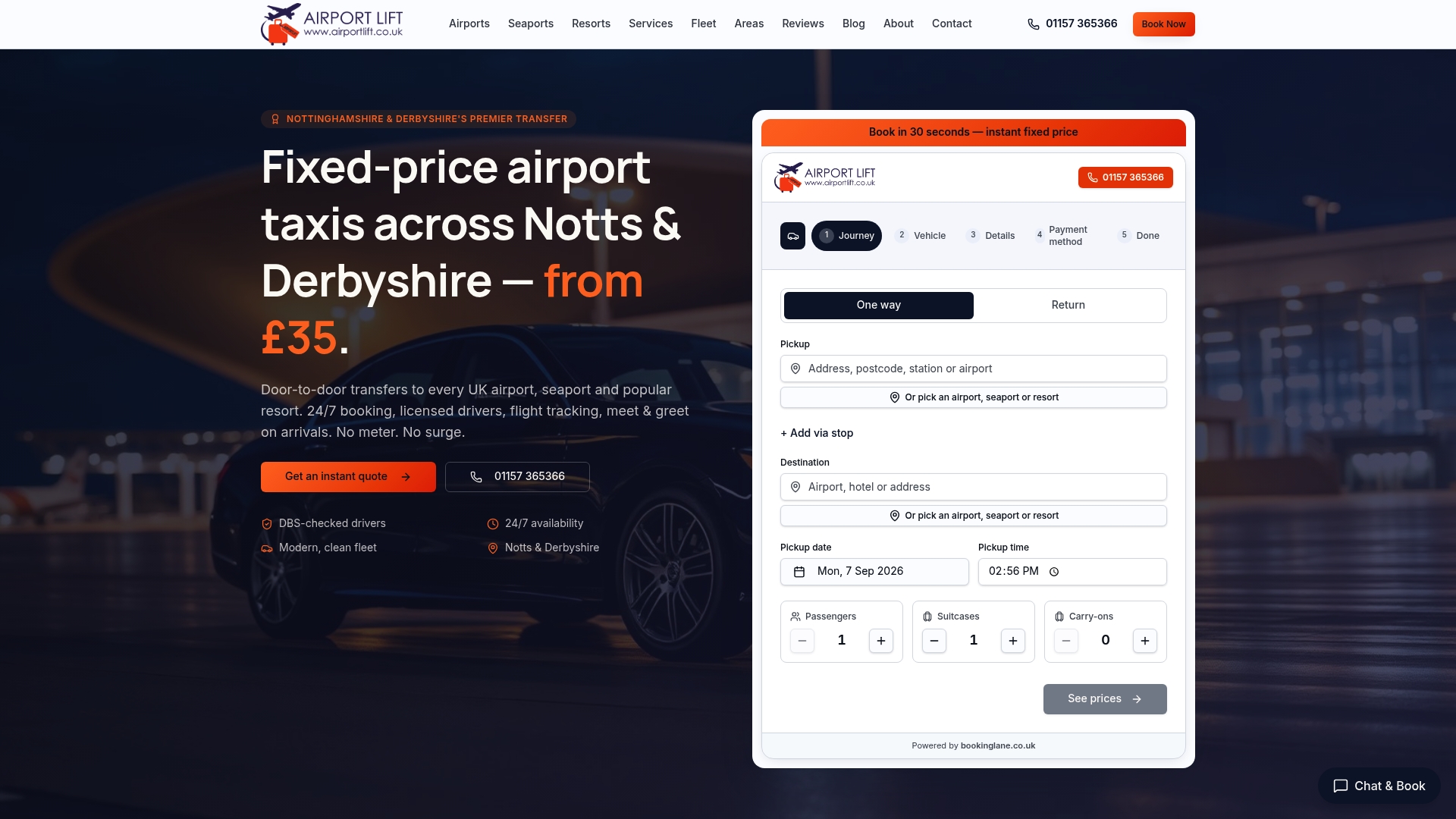
We provide fixed-price airport, seaport and resort transfers across Nottinghamshire and Derbyshire, with executive vehicles, 8-seater minibuses, flight tracking, meet and greet and 24/7 booking. Corporate accounts are invoiced monthly. You can see how our executive travel and group and family transfers work, or get an instant quote on our booking page.
Holidaying staff and teams on away days travel on the same basis. Our fixed prices include resort journeys, such as £55 to Alton Towers and £130 to Skegness and Ingoldmells, listed on our resort transfers page.
Our view on ground transport policy
A travel policy is only as good as the evidence it produces. Most of the problems finance teams describe start with the journey itself: an unknown fare, a driver nobody vetted, a receipt that never arrived.
Our approach is to remove those problems before the journey. You get a fixed price with no hidden fees or surges, an instant quote you can approve in advance, licensed and DBS-checked drivers, and flight tracking so a delay does not become a second fare.
For business clients, we think the cleanest policy sends regular travel through an account with a monthly invoice. The manager approves the booking, the traveller gets on with the trip and finance receives one document at the end of the month.
Whatever you write, make it easy to follow. Employees follow a policy that saves them effort, and ignore one that costs them time.
AirportLift
FAQ
What should a ground transportation policy include?
It should list the vehicle types allowed, who books and approves, the default booking method, the evidence required and what happens in exceptions such as delays or lost receipts. Add a safety rule that vehicles and drivers are licensed. Keep it to a page so staff read it.
How long must we keep taxi receipts and invoices?
HMRC’s employer guidance says to keep expense and benefit records for 3 years from the end of the tax year they relate to. Employees should keep their own records for at least 22 months after the end of the tax year. Ask your accountant about VAT record periods, which differ.
Can employees claim a taxi without a receipt?
That is for your policy to decide. Some organisations accept a written explanation approved by a manager, as Cambridge does where justification is appropriate. Be aware that a missing VAT invoice can stop you recovering VAT on the fare, so pre-booked journeys with invoices are the safer route.
Is a fixed-price transfer better than a metered taxi for business?
For airports and long distances, yes: the price is agreed at booking, so the manager approves a known amount and the claim matches the quote. Our fixed prices run from £35 to East Midlands Airport to £170 to London Gatwick.
Sources
- Travel, Transport, Accommodation and Venue Solutions, GCA
- Employee expenses (part 5), GOV.UK
- Expenses and benefits for employers: record keeping, GOV.UK
- Employees’ responsibilities for travel expenses, GOV.UK
- University of Cambridge employee expenses policy
- Keele University travel reimbursement procedure, July 2026
- Hazlewoods: backdated business mileage rates
- MobileXpense: claiming expenses and receipt details
- Workplace EV charging policy for employers