
Most taxi fare surprises come from three things: extras added to a metered fare, app prices that rise when demand is high, and quotes that are never confirmed before the journey. The simplest way to avoid all three is to book in advance at a fixed price that covers the whole trip. That is how we price every transfer at Airport Lift, from East Midlands Airport at £35 to Heathrow at £160, with no surge and no extras added on the day.
This guide explains what councils and Transport for London (TfL) allow drivers to add, how surge pricing works, what to ask before you get in, and how a fixed fare compares with a metered one on an airport run.
TL;DR
- A metered taxi fare can legitimately include extras: booking fees, airport charges, festive supplements and soiling charges. Each is set by the licensing authority, so the rules differ by area.
- App fares can rise during high demand. A price agreed in advance, in writing, removes that risk.
- Before you travel, ask for the total fare, what it includes and whether tolls, drop-off and parking charges are covered.
- Our transfers are fixed-price: the quote you accept is the fare you pay, with instant quotes and 24/7 booking.
Table of Contents
- What counts as a hidden taxi fee in the UK
- Airport extras you can overlook
- How surge pricing works
- Why a metered fare is hard to predict
- Metered or private hire: where the rules differ
- A checklist to avoid hidden fees before you travel
- Fixed price or metered: a worked comparison
- Book ahead to lock the price
- What we do about hidden fees
- Book a fixed-price transfer
- FAQ
- Sources
What counts as a hidden taxi fee in the UK
A hidden fee is rarely illegal. It is usually a permitted extra the passenger did not know about until the end of the journey. Taxi fares in the UK are set by the local council (in London, by TfL), and each authority publishes a fare card listing what drivers may add to the meter.
London is the clearest example. TfL’s April 2026 fare card allows these extras on a black cab fare:
| Extra | What TfL’s fare card allows |
|---|---|
| Phone, app or online booking | Up to £2.00 |
| Journey starting at a Heathrow taxi rank | £1.60 |
| Drop-off in a Heathrow terminal zone or at the London City Airport forecourt | Up to £6.00 |
| Christmas and New Year supplement | £4.00 |
| Soiling that takes the taxi out of service | Up to £60.00 |
The same card states that there is no extra charge for luggage, additional passengers or paying by card. The festive supplement applies from 20:00 on 24 December to 06:00 on 27 December and from 20:00 on 31 December to 06:00 on 2 January, so it recurs every year. TfL’s fares information leaflet also sets a £4.40 minimum fare.
Outside London the list changes. Highland Council’s tariff page allows a £1.00 phone booking charge, bridge tolls or ferry charges, airport car parking charges with a receipt, and up to £10 for bulky luggage that will not fit in the boot, but only if that was disclosed at booking. Manchester’s public tariff page lists 20p per additional passenger, a £50 fouling charge and separate Manchester Airport charges.

The lesson is not that every extra is a trick. It is that the number on the meter at the start of the journey is not always the number you pay.
Airport extras you can overlook
Airports add their own costs, and these are the ones most likely to appear on a bill after the fact:
- Drop-off fees. Many airports charge vehicles to use the terminal forecourt. At Heathrow, TfL allows up to £6.00 to be passed on to a London taxi passenger.
- Rank or pick-up fees. A taxi leaving a Heathrow rank can add £1.60 under TfL’s rules.
- Parking. In Highland, airport car parking charges can be passed on when a receipt is shown.
- Waiting time. A metered journey keeps running if your flight is late or the queue is long.
- Night and bank holiday tariffs. TfL’s fare card shows a 6-mile daytime journey at £33.00 to £42.00 and the same distance at night at £41.00 to £45.00.
If you are travelling from Nottinghamshire or Derbyshire, our guide to airport drop-off charges in Nottinghamshire and Derbyshire explains how these fees work at the airports you are most likely to use.
How surge pricing works
Surge pricing is different from a hidden fee because it is visible in the app, but it can still catch you out. Fares from app-based services are set by an algorithm that weighs the number of available drivers against the number of ride requests in your area. When demand outruns supply, a multiplier is applied. Taxi Insurer’s explainer gives the example of a £10 fare becoming £25 at a 2.5x multiplier, and lists rush hour, big events and bad weather as common triggers.
Those are exactly the moments when airport travellers are most exposed: early-morning departures, a football match or concert ending, a rainy Sunday evening after a holiday. The multiplier can last minutes or longer, until more drivers arrive. You see the price before you confirm, but you may have no time to wait it out when a flight is leaving.
Metered black cabs and councils’ maximum fares do not surge in this way. A pre-booked fixed price does not either, because the price is agreed once and does not move with demand. Our prices are guaranteed fixed, with no surge and no hidden fees.

Why a metered fare is hard to predict
On a metered journey, the fare depends on things you cannot control: traffic, the route, waiting time, the tariff in force when you set off and any extras. TfL’s April 2026 fare card illustrates how wide the range is. A black cab between Heathrow and central London at Tariff 2 is listed at £70.00 to £120.00, depending on journey time of 30 to 60 minutes.
Councils also warn about how the meter is used. Manchester City Council says the meter should not start until all passengers and their belongings are safely in the vehicle, and that no extra charge can be added for paying by debit or credit card. Somerset Council says a driver cannot demand more than the meter shows apart from soiling and the extras on the council’s maximum fare card.
If you want to see how the same question plays out in another city, there is a comparison of train, taxi or car service options from JFK to Manhattan. The principle is the same: know what each option costs in total, not just the headline rate.
Metered or private hire: where the rules differ
A hackney carriage (the kind you hail or take from a rank) is metered and has a maximum fare set by the council. A private hire vehicle is booked in advance through an operator, and the rules about price are looser. Ashford Borough Council states that private hire fares are not regulated and are a contractual matter between you and the operator. For journeys that end outside the borough, a driver may quote a fixed price above the metered rate, provided you understand what was agreed before you set off.
That is why a fixed price agreed at booking is useful. It turns the fare into something you have already accepted, in writing, rather than something worked out at the end. Our guide to licensed taxis and private hire explains how to tell the two apart and why it matters for insurance and licensing.
A checklist to avoid hidden fees before you travel
These steps follow the advice of councils and GOV.UK, and they work whichever kind of taxi you use.
- Ask for the total fare when you book. Ashford Borough Council advises passengers to ask the fare when booking a private hire journey and to make sure the driver knows the agreed fare at the start.
- Ask what the price includes. Tolls, airport drop-off or parking charges, waiting time and extra stops should each be covered by the quote, not added later.
- Get the quote in writing. A booking confirmation with the price on it settles any disagreement. Our guide to oversized luggage taxis covers confirming space and fare in writing when you have bulky bags.
- Check the vehicle displays its fare card. Manchester City Council says hackney carriages must display a council-issued fare card, and private hire vehicles must display one that must be used.
- Know what a driver should do. GOV.UK’s best-practice sample notices say a private hire driver must make sure you know the estimated fare before setting off, take the most time-efficient route and explain any diversion.
- Confirm how you will pay. Card payments cannot carry an extra charge in Manchester or London. Our guide to paying by card in UK taxis has a short checklist.
- Report problems. Somerset Council asks passengers to report a driver who does not use the meter, demands more than it shows or takes a longer route. Report it to the council that licensed the vehicle.
Fixed price or metered: a worked comparison
Take a family of four leaving Nottingham for East Midlands Airport on an early morning flight. With a metered journey, you pay what the meter says plus any permitted extras, and the total depends on traffic and route. With our transfer, the fare to East Midlands Airport is £35, the price you see in your quote.
Now take a longer journey: Nottingham to Manchester Airport at £100, Leeds Bradford at £70, or Heathrow at £160. On a distance like Heathrow, a meter running through motorway congestion is exactly where an unpredictable fare costs most. A fixed fare means the traffic is our problem, not your bill. Our article on fixed-price versus metered taxis walks through the comparison in more detail, and our guide to long-distance fixed-price taxis covers longer trips.
| Destination from Nottinghamshire and Derbyshire | Our fixed price |
|---|---|
| East Midlands Airport | £35 |
| Leeds Bradford Airport | £70 |
| Birmingham Airport | £75 |
| Manchester Airport | £100 |
| London Luton | £120 |
| London Stansted | £130 |
| London Heathrow | £160 |
| London Gatwick | £170 |
| Liverpool Cruise Terminal | £200 |
| Southampton Cruise Port | £280 |
| Dover Cruise and Ferry Port | £355 |
The same applies to days out and holidays: Alton Towers is £55, Skegness and Ingoldmells £130, and Blackpool or Scarborough £200.
Book ahead to lock the price
Booking ahead is the single most effective way to avoid a surprise. A fare agreed before the day cannot be changed by a surge, a busy rank or a late-night tariff. Our guides on prebooking an airport taxi and on prebooked taxis versus on-demand rides explain when each makes sense.
For airport journeys, there is a practical advantage too. Your driver is waiting for a time you have set, and with flight tracking on arrivals, a delayed flight is followed rather than costing you extra. For arrivals, meet and greet means the driver is there when you come through the terminal.
What we do about hidden fees
Our approach is simple. We quote one fixed price for the transfer, you see it instantly when you book, and that is the price. Drivers are fully licensed and DBS-checked. Booking is open 24 hours a day, so an early or late flight is no obstacle. We offer executive vehicles for business travel, 8-seater minibuses for families and groups, and monthly invoicing for corporate accounts, so regular travellers get a clear record rather than a stack of receipts.
Our view on hidden taxi fees
A fare should be something you know before you travel, not something you discover at the end. Metered fares have their place in a city centre, where you hail a cab for a short hop. For an airport run, where the stakes are a flight and a family with luggage, we think certainty matters more than flexibility.
That is why we price transfers as a fixed fare with no hidden fees and no surges. You get an instant quote, you know what you will pay, and our licensed, DBS-checked drivers track your flight so a delay does not turn into an argument about waiting time.
The most useful thing a traveller can do is ask one question before booking: “Is this the total price?” With us, the answer is yes.
AirportLift
Book a fixed-price transfer
If you live in Nottinghamshire or Derbyshire and want to know exactly what your airport, seaport or resort journey will cost, you can get an instant quote and book in a few minutes. The full list of airports, from East Midlands at £35 to Heathrow at £160, is on our airport transfers page.
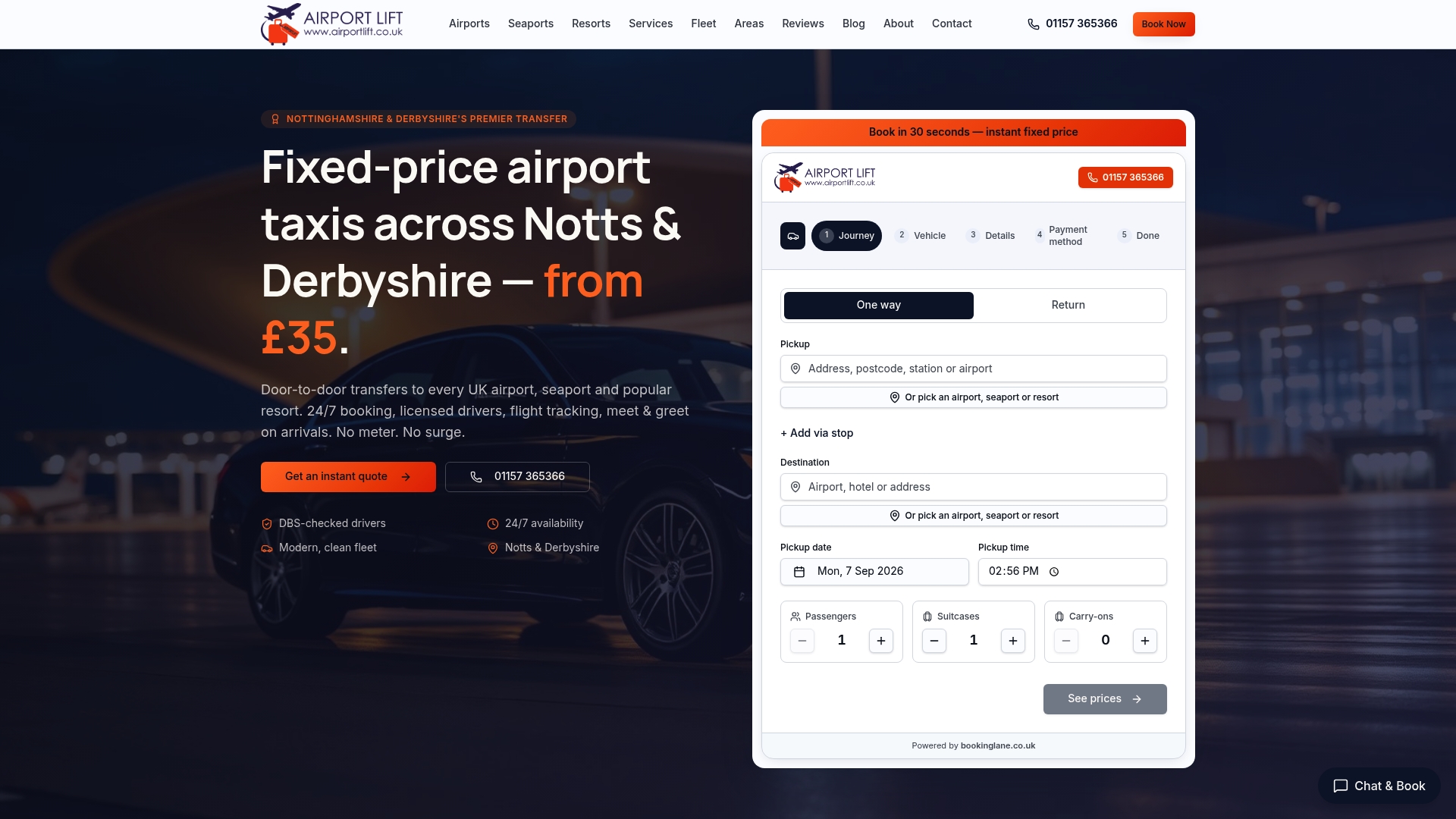
Business travellers can look at our executive travel service, and families or groups can book an 8-seater through our services page. If you are arriving and want someone waiting for you, see meet and greet.
FAQ
Can a taxi driver charge more than the meter?
Generally not. Somerset Council says a driver cannot demand more than the meter shows, except for soiling and the other extras on the council’s maximum fare card. A fixed price can differ from the meter if it was agreed before the journey, so always confirm what you are paying at the start.
Do taxis charge extra for luggage or card payments?
In London, no. TfL’s April 2026 fare card states there is no extra charge for luggage, additional passengers or card payment. Rules vary elsewhere: Highland Council allows up to £10 for bulky luggage that will not fit in the boot, but only if that was disclosed at booking. Manchester City Council says no extra charge can be added for card payments.
How do I avoid surge pricing?
Surge pricing responds to demand at your location, so the most reliable way to avoid it is to agree a fixed price in advance. Pre-booking an airport transfer means the fare is set once and does not change with rush hour, events or weather. Our transfers are fixed-price, so the quote you accept is the fare you pay.
What should I ask before booking an airport taxi?
Ask for the total price, what it includes (tolls, drop-off and parking charges, waiting time) and whether you will get it in writing. Ashford Borough Council also suggests getting prices from two or more licensed operators when you book private hire. A written confirmation showing the fare is your protection if anything is disputed later.
Sources
- TfL taxi fare card, April 2026
- TfL taxi fares information
- Highland Council taxi and private hire tariffs
- Manchester City Council public taxi fares and charges
- Manchester City Council taxi fares and charges
- Somerset Council advice for taxi passengers
- Ashford Borough Council information for customers
- GOV.UK sample notices for taxi and private hire passengers
- Taxi Insurer: surge pricing explained
- JFK to Manhattan: train, taxi or car service compared